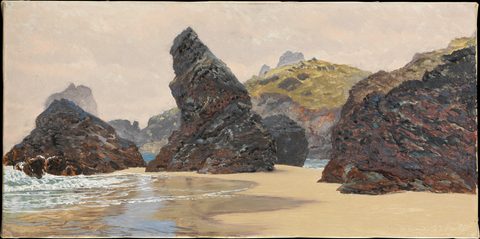
Kynance
John Brett, 1888
Turquoise pools in dark rock. Cornwall light after the tide goes out.
About this work
Turquoise pools and wet sand lie between dark serpentine rocks at low tide in Kynance, an 1888 oil on canvas by the English painter John Brett, now in The Metropolitan Museum of Art in New York. Brett painted the cove in clear, even daylight with the precise detail he had learned from Pre-Raphaelite practice. Kynance Cove is on the western side of the Lizard peninsula in Cornwall, about two miles north of Lizard Point, the southernmost tip of mainland Britain. It is known for its white sand, clear water and dramatic stacks and islands of green and red serpentine rock. The cove became fashionable in the early Victorian era, visited by Queen Victoria and Prince Albert and by the poets Alfred Tennyson and Algernon Swinburne, and it is now owned by the National Trust. Brett, born in 1831, was associated with the Pre-Raphaelite movement, and his painting The Stonebreaker and his Val d'Aosta were praised by John Ruskin. He was also a keen amateur astronomer and a Fellow of the Royal Astronomical Society. From the 1870s he spent his summers sailing around the coasts of Britain, sketching for the large seascapes he showed at the Royal Academy. He died in 1902.
Sources: The Metropolitan Museum of Art · Wikipedia: Kynance Cove · Wikipedia: John Brett (artist)
FAQ
Where can I buy a framed print of Kynance?
Here. Kynance is available as a framed print in three sizes: Small (20 × 10 in) for $195, Medium (24 × 12 in) for $295 and Large (36 × 18 in) for $395. Prices include the frame and US shipping; delivery takes 14–21 days, with 30-day returns.
What size works best for Kynance?
The file is 3,901 × 1,944 px. Medium (24 × 12 in) is the largest size that prints at 150 ppi or more (162 ppi), the sharpest choice for close viewing; Large (36 × 18 in) prints at 108 ppi, fine from a few feet away but softer up close.
Is it legal to print Kynance?
Yes. The Metropolitan Museum of Art lists this painting as public domain and releases its image under its Open Access program (CC0), so it can be printed and sold freely. John Brett died in 1902.
















