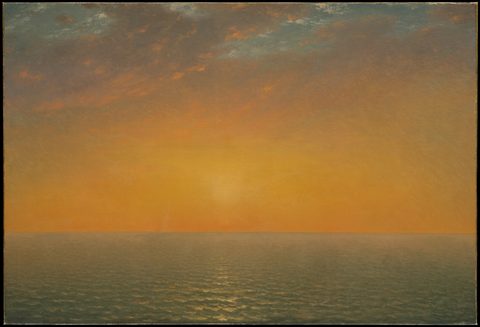
Sunset on the Sea
John Frederick Kensett, 1872
No shore. No ship. Just a gold sky meeting a dark sea. The light does the talking. The water answers in ripples.
About this work
Sunset on the Sea is an oil on canvas of 28 by 41 1/8 inches painted by John Frederick Kensett in 1872, the last year of his life. It belongs to the Metropolitan Museum of Art in New York (74.3), the gift of Thomas Kensett in 1874. There is no shore, no ship and no figure: only a calm sea, rippling toward the viewer, beneath a vast sky of gold and amber where the sun sinks into haze on the horizon. Kensett was born in Cheshire, Connecticut, in 1816 and trained as an engraver with his father, Thomas Kensett, an English immigrant, before working as a banknote engraver in New York. In 1840 he sailed to Europe with Asher Durand and John William Casilear to study painting, and on his return he became one of the leading members of the second generation of the Hudson River School. In the early 1870s he spent much of his time on Contentment Island, on Long Island Sound near Darien, Connecticut, where he painted spare, luminous seascapes such as Eaton's Neck, Long Island, also at the Met. He was a founder of the Metropolitan Museum and was generous to fellow artists. He died in New York in December 1872.
Sources: The Metropolitan Museum of Art · Wikipedia: John Frederick Kensett
FAQ
Where can I buy a framed print of Sunset on the Sea?
Here. Sunset on the Sea is available as a framed print in three sizes: Small (20 × 14 in) for $195, Medium (24 × 16 in) for $295 and Large (36 × 25 in) for $395. Prices include the frame and US shipping; delivery takes 14–21 days, with 30-day returns.
What size works best for Sunset on the Sea?
The file is 3,811 × 2,597 px. Medium (24 × 16 in) is the largest size that prints at 150 ppi or more (159 ppi), the sharpest choice for close viewing; Large (36 × 25 in) prints at 104 ppi, fine from a few feet away but softer up close.
Is it legal to print Sunset on the Sea?
Yes. Sunset on the Sea is in the public domain: its copyright, if it ever had one, expired long ago. In the United States a faithful photograph of a public-domain painting does not create a new copyright (Bridgeman v. Corel, 1999), so the image can be printed and sold freely.
















