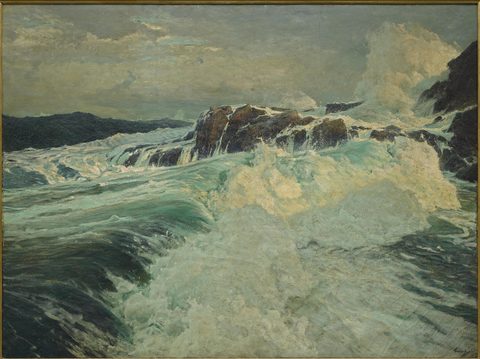
Roaring Main
Frederick Judd Waugh, 1909
Green water climbs the rocks. Foam blows inland. The sky is open over the break.
About this work
Frederick Judd Waugh painted Roaring Main in 1909, the year after he returned to the United States from England. Heavy surf breaks over dark rocks along a shore, and teal and white water churns in the foreground under a clouded sky. "Main" is an old poetic word for the open sea. The canvas is large, 54 by 72 inches, about 137 by 183 centimetres. It was given to the Dallas Museum of Art by the Dallas Fair Association (1912.3). Waugh was born in Bordentown, New Jersey, in 1861. He studied at the Pennsylvania Academy of the Fine Arts with Thomas Eakins and at the Académie Julian in Paris. He then spent years in England, living on the Channel island of Sark, where he made his living as a seascape painter. Back in America he settled in Montclair, New Jersey, and later lived on Bailey Island in Maine and in Provincetown, Massachusetts. During the First World War he designed camouflage for U.S. Navy ships. His paintings of the sea were enormously popular: he won the Popular Prize at the Carnegie International exhibition five years in a row. He died in 1940, and he remains one of the best-known American painters of surf and rocky coasts.
Sources: Dallas Museum of Art · Wikimedia Commons · Wikipedia: Frederick Judd Waugh
FAQ
Where can I buy a framed print of Roaring Main?
Here. Roaring Main is available as a framed print in three sizes: Small (20 × 15 in) for $195, Medium (24 × 18 in) for $295 and Large (36 × 27 in) for $395. Prices include the frame and US shipping; delivery takes 14–21 days, with 30-day returns.
What size works best for Roaring Main?
The file is 9,035 × 6,762 px, so every size is sharp: even Large (36 × 27 in) prints at 250 ppi. Choose Large (36 × 27 in) for a large wall; Small (20 × 15 in) suits a narrower space.
Is it legal to print Roaring Main?
Yes. Roaring Main is in the public domain: its copyright, if it ever had one, expired long ago. In the United States a faithful photograph of a public-domain painting does not create a new copyright (Bridgeman v. Corel, 1999), so the image can be printed and sold freely.

















