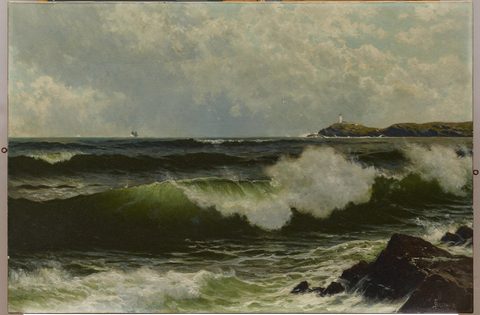
Seascape
Alfred Thompson Bricher, c. 1870s
Open Atlantic under a high sky. Bricher light on the swell.
About this work
This Seascape by Alfred Thompson Bricher looks out over the open Atlantic under a high sky, with light playing across the swell. The Dallas Museum of Art, which received it in 1990 as the bequest of Margaret M. Ferris (1990.151), dates it to about 1885–90. The oil on canvas measures about 51 by 77 centimetres. Bricher was born in Portsmouth, New Hampshire, in 1837 and educated at an academy in Newburyport, Massachusetts. He began in business in Boston, studying at the Lowell Institute in his spare time and later with painters including Albert Bierstadt and William Morris Hunt, and he took up painting as a profession after 1858. After moving to New York in 1868 he turned increasingly to watercolour and to the sea. In the 1870s maritime subjects became his main theme, and he often spent summers on the island of Grand Manan in the Bay of Fundy. He became an associate of the National Academy of Design in 1879. In the 1890s he bought a house by the sea at New Dorp on Staten Island, with views of Lower New York Bay and the Atlantic, and painted there until his death in 1908. Interest in his work revived in the 1980s, when he came to be counted among the great maritime painters of the nineteenth century.
Sources: Dallas Museum of Art · Wikimedia Commons · Wikipedia: Alfred Thompson Bricher
FAQ
Where can I buy a framed print of Seascape?
Here. Seascape is available as a framed print in three sizes: Small (20 × 13 in) for $195, Medium (24 × 16 in) for $295 and Large (36 × 24 in) for $395. Prices include the frame and US shipping; delivery takes 14–21 days, with 30-day returns.
What size works best for Seascape?
The file is 9,775 × 6,423 px, so every size is sharp: even Large (36 × 24 in) prints at 268 ppi. Choose Large (36 × 24 in) for a large wall; Small (20 × 13 in) suits a narrower space.
Is it legal to print Seascape?
Yes. Seascape is in the public domain: its copyright, if it ever had one, expired long ago. In the United States a faithful photograph of a public-domain painting does not create a new copyright (Bridgeman v. Corel, 1999), so the image can be printed and sold freely.

















