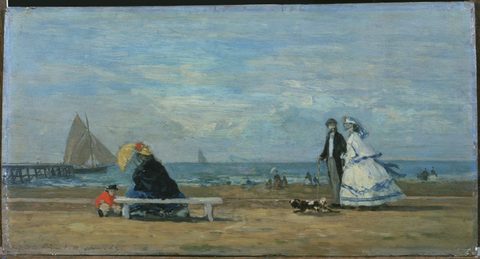
Beach at Trouville
Eugène Boudin, 1863
A long pale beach under a working sky. People are small. The weather is the subject. Normandy never pretends.
About this work
Beach at Trouville is a small oil on wood panel, 7 1/4 by 13 3/4 inches, painted by Eugène Boudin in 1863. It belongs to The Phillips Collection in Washington (0191), which acquired it in 1923 and hangs it in the Music Room of the Phillips house. A woman sits on a bench under a yellow parasol with a child beside her, a strolling couple in crinolines walks along the sand at the right, and a dog runs between them, while sailboats lie off a long jetty under a wide pale sky. The Phillips notes that, despite its quick look, the picture was probably composed from sketches made on the spot, and several reworked areas show how carefully Boudin arranged the figures. Unlike most of his beach scenes, which show crowds set deep in space, it is a close view of just a few people; the running dog, the seated woman and the strolling couple reappear in other beach scenes of 1863. Trouville, on the Normandy coast near Boudin's home town of Honfleur, became a fashionable resort in the nineteenth century. Boudin, born in 1824, was one of the first French landscape painters to work outdoors, and Corot called him the king of the skies.
Sources: The Phillips Collection · Wikipedia: Eugène Boudin · Wikipedia: Trouville-sur-Mer
FAQ
Where can I buy a framed print of Beach at Trouville?
Here. Beach at Trouville is available as a framed print in three sizes: Small (20 × 11 in) for $195, Medium (24 × 13 in) for $295 and Large (36 × 19 in) for $395. Prices include the frame and US shipping; delivery takes 14–21 days, with 30-day returns.
What size works best for Beach at Trouville?
The file is 4,001 × 2,157 px. Medium (24 × 13 in) is the largest size that prints at 150 ppi or more (166 ppi), the sharpest choice for close viewing; Large (36 × 19 in) prints at 111 ppi, fine from a few feet away but softer up close.
Is it legal to print Beach at Trouville?
Yes. Beach at Trouville is in the public domain: its copyright, if it ever had one, expired long ago. In the United States a faithful photograph of a public-domain painting does not create a new copyright (Bridgeman v. Corel, 1999), so the image can be printed and sold freely.
















