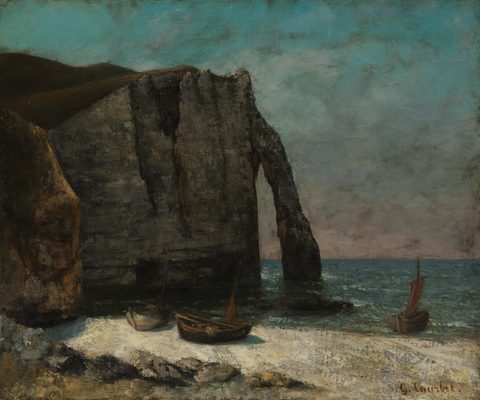
The Cliff at Étretat
Gustave Courbet, c. 1869
White chalk wall over green water. The arch holds. Normandy throws its weight at the sea.
About this work
The Cliff at Étretat is an oil on fabric of 54.5 by 65.5 centimetres in the Cleveland Museum of Art (1929.465), the gift of the Estate of Charles F. Brush. It is catalogued under Gustave Courbet, and the museum dates it to after 1872, several years after the artist's own stay on that coast, and from 1873 Courbet lived in exile in Switzerland. The picture shows the white chalk wall of the cliffs at Étretat rising over green water, with one of the great natural arches standing out into the sea. Courbet first painted at Étretat in the summer of 1869, when he made his famous views of the cliffs and of waves breaking on the shore. Étretat is a small seaside town on the Normandy coast, known for its dramatic chalk cliffs and sea arches. It became a favourite of painters in the nineteenth century, and Claude Monet painted about fifty views of its cliffs in the 1880s. Courbet, born in Ornans in 1819, led the Realist movement in French painting. Committed to painting only what he could see, he rejected academic convention and the Romanticism of the generation before him. His independence and bold social statements made him an example for the Impressionists and later for the Cubists. He died in Switzerland in 1877.
Sources: Cleveland Museum of Art · Wikipedia: Gustave Courbet · Wikipedia: Cliffs at Étretat
FAQ
Where can I buy a framed print of The Cliff at Étretat?
Here. The Cliff at Étretat is available as a framed print in three sizes: Small (20 × 17 in) for $195, Medium (24 × 20 in) for $295 and Large (36 × 30 in) for $395. Prices include the frame and US shipping; delivery takes 14–21 days, with 30-day returns.
What size works best for The Cliff at Étretat?
The file is 6,930 × 5,768 px, so every size is sharp: even Large (36 × 30 in) prints at 192 ppi. Choose Large (36 × 30 in) for a large wall; Small (20 × 17 in) suits a narrower space.
Is it legal to print The Cliff at Étretat?
Yes. The Cliff at Étretat is in the public domain: its copyright, if it ever had one, expired long ago. In the United States a faithful photograph of a public-domain painting does not create a new copyright (Bridgeman v. Corel, 1999), so the image can be printed and sold freely.
















