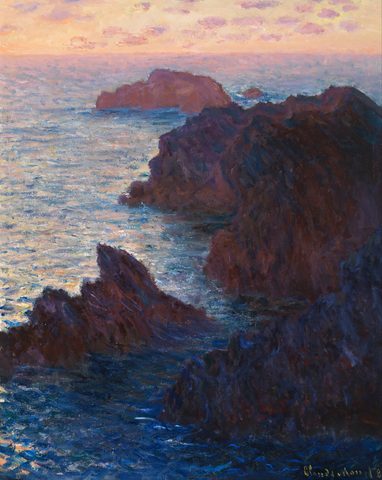
Rocks at Belle-Île, Port-Domois
Claude Monet, 1886
Belle-Île cliffs at Port-Domois. Monet rock and Atlantic force.
About this work
Rocks at Belle-Île, Port-Domois is an oil on canvas painted by Claude Monet in 1886 and now in the Cincinnati Art Museum. It shows the dark, broken cliffs of Port-Domois on the island's wild Atlantic side, with the sea churning green and white around the rocks below. Monet went to Belle-Île in September 1886 expecting a short stay and remained for about ten weeks, painting the coast in all weathers; the Belle-Île pictures are among his most forceful seascapes. Belle-Île, or Belle-Île-en-Mer, lies 14 kilometres off the Quiberon peninsula in the Morbihan département and is the largest of Brittany's islands. It measures about 17 by 9 kilometres, and its coastline mixes placid beaches with the sharp, dangerous cliffs of the south-west shore, known as the Côte Sauvage, or wild coast. Monet was born in Paris in 1840 and grew up in Le Havre, where he learned to paint outdoors. He founded Impressionism, a name taken from his Impression, Sunrise, shown at the first Impressionist exhibition in 1874, and he remained its most consistent practitioner, painting landscapes and the sea as he perceived them in changing light.
Sources: Wikimedia Commons · Wikipedia: Claude Monet · Wikipedia: Belle-Île
FAQ
Where can I buy a framed print of Rocks at Belle-Île, Port-Domois?
Here. Rocks at Belle-Île, Port-Domois is available as a framed print in three sizes: Small (16 × 20 in) for $195, Medium (19 × 24 in) for $295 and Large (29 × 36 in) for $395. Prices include the frame and US shipping; delivery takes 14–21 days, with 30-day returns.
What size works best for Rocks at Belle-Île, Port-Domois?
The file is 3,292 × 4,133 px. Medium (19 × 24 in) is the largest size that prints at 150 ppi or more (172 ppi), the sharpest choice for close viewing; Large (29 × 36 in) prints at 114 ppi, fine from a few feet away but softer up close.
Is it legal to print Rocks at Belle-Île, Port-Domois?
Yes. Rocks at Belle-Île, Port-Domois is in the public domain: its copyright, if it ever had one, expired long ago. In the United States a faithful photograph of a public-domain painting does not create a new copyright (Bridgeman v. Corel, 1999), so the image can be printed and sold freely.

















