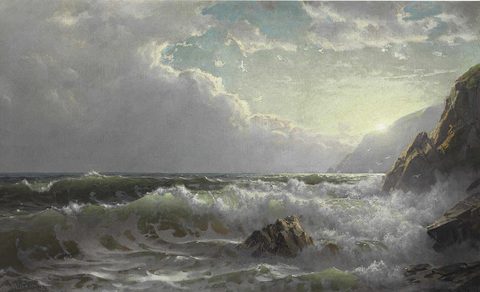
Off the Coast of Cornwall
William Trost Richards, 1904
Green rollers. A low headland. Daylight on the open Atlantic.
About this work
Big green rollers surge toward the foot of dark cliffs, breaking into white spray beneath a heavy, cloudy sky with a patch of brightness above. William Trost Richards painted Off the Coast of Cornwall in the early 1900s; the auction record behind the image on Wikimedia Commons, a Christie's sale, dates it to 1904. The painting is in a private collection.
Richards was an American landscape painter associated with the Hudson River School and with the American Pre-Raphaelites, a group devoted to precise observation of nature. He rejected the romanticized approach of many of his peers in favor of meticulous, factual rendering, and in later years he painted almost exclusively marine subjects. He died in Newport, Rhode Island, in 1905.
That precision is on full display here. Follow a single wave from the dark trough to the translucent green crest and the foam at its edge; the water has weight and depth. The low horizon gives the sky room to build.
The scan is 3200 × 1947 pixels, a horizontal frame. It is a powerful piece for a study, a coastal home or a room that needs a strong focal point, and a natural gift for sailors and surfers.
Public domain; image via Wikimedia Commons.
Sources: Wikimedia Commons · Wikipedia: William Trost Richards
FAQ
Where can I buy a framed print of Off the Coast of Cornwall?
Here. Off the Coast of Cornwall is available as a framed print in two sizes: Small (20 × 12 in) for $195 and Medium (24 × 15 in) for $295. Prices include the frame and US shipping; delivery takes 14–21 days, with 30-day returns.
What size works best for Off the Coast of Cornwall?
The file is 3,200 × 1,947 px. Small (20 × 12 in) is the largest size that prints at 150 ppi or more (160 ppi), the sharpest choice for close viewing; Medium (24 × 15 in) prints at 130 ppi, fine from a few feet away but softer up close.
Is it legal to print Off the Coast of Cornwall?
Yes. Off the Coast of Cornwall is in the public domain: its copyright, if it ever had one, expired long ago. In the United States a faithful photograph of a public-domain painting does not create a new copyright (Bridgeman v. Corel, 1999), so the image can be printed and sold freely.

















