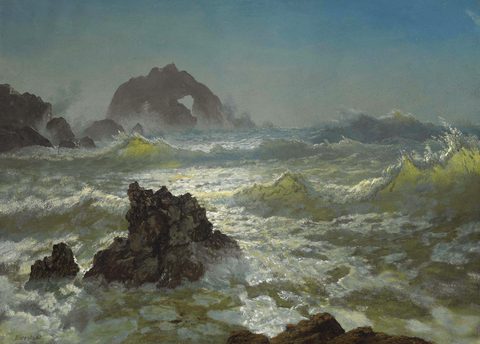
Seal Rock, California
Albert Bierstadt, c. 1872–1887
Surf hits the rock. Spray climbs the air. The Pacific keeps coming.
About this work
Seal Rock, California is an oil on paper mounted on canvas, 40.6 by 55.9 centimetres, painted by Albert Bierstadt about 1872. It was sold at Christie's in New York on 18 May 2011 (sale 2444, lot 37); it had earlier been with Hirschl and Adler Galleries in New York, from whom its owner acquired it in 1975. Green Pacific breakers smash against dark rocks in the foreground, spray hangs in the air, and the arched shape of the rock rises out of the surf against a pale sky. Seal Rocks are a group of small rocky islands just offshore from the Lands End area of San Francisco, at the north end of Ocean Beach, near the Cliff House and the ruins of the Sutro Baths. They take their name from the Steller sea lions and California sea lions that haul out on them, both often called seals. Bierstadt was based in San Francisco between 1871 and 1873 and made many sketches of the coast, the Sierra Nevada and Yosemite in those years. A quick study on paper like this one let him catch the movement of the water and the spray while the impression was fresh.
Sources: Wikimedia Commons · Wikipedia: Seal Rocks (San Francisco) · Wikipedia: Albert Bierstadt
FAQ
Where can I buy a framed print of Seal Rock, California?
Here. Seal Rock, California is available as a framed print in two sizes: Small (20 × 14 in) for $195 and Medium (24 × 17 in) for $295. Prices include the frame and US shipping; delivery takes 14–21 days, with 30-day returns.
What size works best for Seal Rock, California?
The file is 3,200 × 2,297 px. Small (20 × 14 in) is the largest size that prints at 150 ppi or more (160 ppi), the sharpest choice for close viewing; Medium (24 × 17 in) prints at 133 ppi, fine from a few feet away but softer up close.
Is it legal to print Seal Rock, California?
Yes. Seal Rock, California is in the public domain: its copyright, if it ever had one, expired long ago. In the United States a faithful photograph of a public-domain painting does not create a new copyright (Bridgeman v. Corel, 1999), so the image can be printed and sold freely.

















