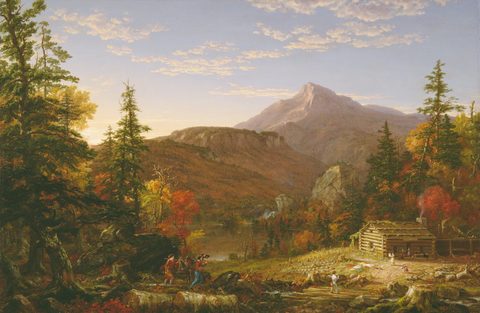
The Hunter's Return
Thomas Cole, 1845
They are almost home. The cabin smokes. The garden is in. A boy runs the log bridge. The mountain is still the whole sky.
About this work
Thomas Cole painted The Hunter's Return in 1845 for an important New York patron, and signed and dated it at lower centre. In an autumn valley a settler family has carved a small farm out of the woods. Father and son stride out of the forest carrying the prize of a successful hunt toward their log cabin, fresh cabbages dot the slope that runs down to a lake, and a rocky peak rises beyond the bright fall trees. The Amon Carter Museum of American Art in Fort Worth, which owns the painting (1983.156), notes that it suggests a bountiful life in harmony with nature. By then, however, industry had already thinned the forests of the Northeast. From his home in Catskill, New York, Cole watched railroad building and leather tanning clear the woods, and he lamented what he called the "ravages of the axe". The stumps in the foreground stand both for progress and for nature's fragility. The canvas measures 40⅛ by 60½ inches. Cole was born in Bolton le Moors, Lancashire, in 1801, emigrated to the United States in 1818, and is regarded as the founder of the Hudson River School. He died in 1848.
Sources: Amon Carter Museum of American Art · Wikipedia: Thomas Cole
FAQ
Where can I buy a framed print of The Hunter's Return?
Here. The Hunter's Return is available as a framed print in three sizes: Small (20 × 13 in) for $195, Medium (24 × 16 in) for $295 and Large (36 × 23 in) for $395. Prices include the frame and US shipping; delivery takes 14–21 days, with 30-day returns.
What size works best for The Hunter's Return?
The file is 11,624 × 7,568 px, so every size is sharp: even Large (36 × 23 in) prints at 323 ppi. Choose Large (36 × 23 in) for a large wall; Small (20 × 13 in) suits a narrower space.
Is it legal to print The Hunter's Return?
Yes. The Hunter's Return is in the public domain: its copyright, if it ever had one, expired long ago. In the United States a faithful photograph of a public-domain painting does not create a new copyright (Bridgeman v. Corel, 1999), so the image can be printed and sold freely.
















