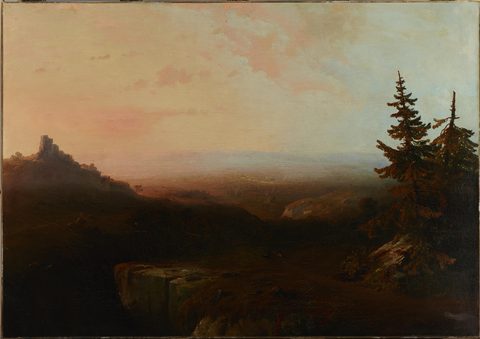
Mountain Scene
Thomas Moran, 1865
Early Moran — a mountain gorge with water and sky in grand Hudson River manner.
About this work
Mountain Scene is an oil on canvas painted by Thomas Moran in about 1865. It belongs to the Dallas Museum of Art (1987.479), which publishes its public domain works for free download. Dusk settles over a wide mountain valley: a ruined tower stands on a crag at the left, two tall evergreens rise from a rocky outcrop at the right, and a hazy ridge fades into a sky of pink and gold. Moran was born in Bolton, Lancashire, in 1837 and came to the United States with his family at the age of seven, settling near Philadelphia. He started as an apprentice wood engraver and painted watercolours in his spare time. Illustrated books of J. M. W. Turner's work became a lasting influence on him, and in 1862 he travelled to England to see Turner's paintings for himself; from then on he followed Turner's use of colour and choice of landscape. This picture comes from those years, before the West. In 1871 Ferdinand Hayden invited him on the expedition to Yellowstone, and his images of it helped bring about the creation of Yellowstone National Park in 1872. He died in Santa Barbara, California, in 1926.
Sources: Dallas Museum of Art · Wikimedia Commons · Wikipedia: Thomas Moran
FAQ
Where can I buy a framed print of Mountain Scene?
Here. Mountain Scene is available as a framed print in three sizes: Small (20 × 14 in) for $195, Medium (24 × 17 in) for $295 and Large (36 × 25 in) for $395. Prices include the frame and US shipping; delivery takes 14–21 days, with 30-day returns.
What size works best for Mountain Scene?
The file is 10,160 × 7,174 px, so every size is sharp: even Large (36 × 25 in) prints at 282 ppi. Choose Large (36 × 25 in) for a large wall; Small (20 × 14 in) suits a narrower space.
Is it legal to print Mountain Scene?
Yes. Mountain Scene is in the public domain: its copyright, if it ever had one, expired long ago. In the United States a faithful photograph of a public-domain painting does not create a new copyright (Bridgeman v. Corel, 1999), so the image can be printed and sold freely.

















