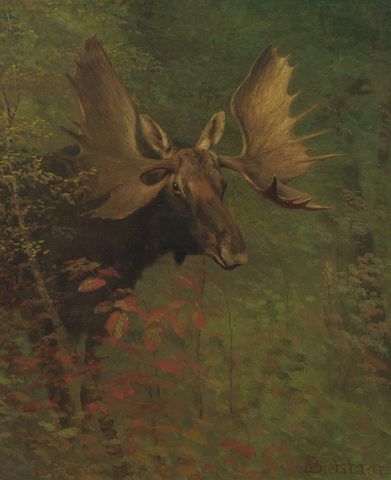
Study of a Moose
Albert Bierstadt, 1880
Albert Bierstadt's oil study of a moose, painted on paper. It sold at Sotheby's New York in April 2012.
About this work
Study of a Moose is an undated oil on cardboard of 64.8 by 54 centimetres by Albert Bierstadt. It was sold at Sotheby's in New York on 5 April 2012 as lot 48. A bull moose lies in long grass with its broad palmate antlers spread, painted quickly and close up, the background left as loose strokes of green and brown. Bierstadt made oil sketches of animals and landscape details on his travels as material for his large studio paintings; in 1859 he first went west with the government surveyor Frederick W. Lander. The moose is the largest and heaviest living species of deer, and most adult males carry broad, hand-shaped antlers rather than the branching antlers of other deer. Unlike most deer, moose do not form herds; they live alone in the boreal and mixed forests of the northern hemisphere, and the largest populations are in Canada. Bierstadt, born in Solingen, Germany, in 1830, grew up in New Bedford, Massachusetts, and studied in Düsseldorf. His grand views of the Rocky Mountains, the Sierra Nevada and Yosemite made him the most famous painter of the American West in his day. He died in 1902.
Sources: Wikimedia Commons · Wikipedia: Albert Bierstadt · Wikipedia: Moose
FAQ
Where can I buy a framed print of Study of a Moose?
Here. Study of a Moose is available as a framed print in three sizes: Small (16 × 20 in) for $195, Medium (20 × 24 in) for $295 and Large (29 × 36 in) for $395. Prices include the frame and US shipping; delivery takes 14–21 days, with 30-day returns.
What size works best for Study of a Moose?
The file is 3,256 × 4,000 px. Medium (20 × 24 in) is the largest size that prints at 150 ppi or more (163 ppi), the sharpest choice for close viewing; Large (29 × 36 in) prints at 111 ppi, fine from a few feet away but softer up close.
Is it legal to print Study of a Moose?
Yes. Study of a Moose is in the public domain: its copyright, if it ever had one, expired long ago. In the United States a faithful photograph of a public-domain painting does not create a new copyright (Bridgeman v. Corel, 1999), so the image can be printed and sold freely.

















