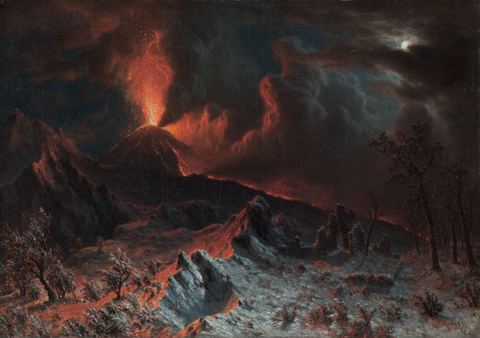
Mount Vesuvius at Midnight
Albert Bierstadt, 1868
An American in Italy, a volcano at midnight. Fire that would not be left alone. Naples glows. The mountain writes in red. Sleep is cancelled.
About this work
Albert Bierstadt painted Mount Vesuvius at Midnight in 1868. The oil on canvas, 42.6 by 60.7 centimetres, is in the Cleveland Museum of Art (1949.541), a gift of members of the Mather family. According to the museum, Bierstadt was living in London in 1868 when he heard that the volcano had become active again, and he went to Italy at once. It is not certain that he actually saw an eruption, but the painting gives a convincing picture of the lava and ash. The Cleveland canvas is a smaller version of a much larger painting that is now lost. Vesuvius stands on the Gulf of Naples about nine kilometres east of the city. Its eruption of 79 AD destroyed Pompeii, Herculaneum and other Roman towns. Bierstadt, born in Germany in 1830 and raised in Massachusetts, was by then famous for his huge views of the American West. He made this trip on the long European tour he began in 1867, when he arrived in London to exhibit his work.
Sources: Cleveland Museum of Art · Wikipedia: Albert Bierstadt · Wikipedia: Mount Vesuvius
FAQ
Where can I buy a framed print of Mount Vesuvius at Midnight?
Here. Mount Vesuvius at Midnight is available as a framed print in three sizes: Small (20 × 14 in) for $195, Medium (24 × 17 in) for $295 and Large (36 × 25 in) for $395. Prices include the frame and US shipping; delivery takes 14–21 days, with 30-day returns.
What size works best for Mount Vesuvius at Midnight?
The file is 4,780 × 3,366 px. Medium (24 × 17 in) is the largest size that prints at 150 ppi or more (198 ppi), the sharpest choice for close viewing; Large (36 × 25 in) prints at 133 ppi, fine from a few feet away but softer up close.
Is it legal to print Mount Vesuvius at Midnight?
Yes. Mount Vesuvius at Midnight is in the public domain: its copyright, if it ever had one, expired long ago. In the United States a faithful photograph of a public-domain painting does not create a new copyright (Bridgeman v. Corel, 1999), so the image can be printed and sold freely.
















