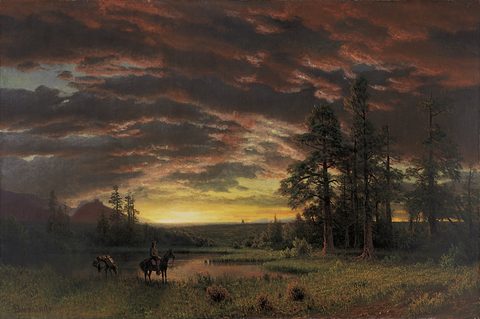
Evening on the Prairie
Albert Bierstadt, 1870
The grass goes flat to a fire of sky. Nothing moves but the light. The prairie keeps its own weather.
About this work
This sunset scene by Albert Bierstadt, painted about 1870, belongs to the Museo Nacional Thyssen-Bornemisza in Madrid (inventory 468, 1981.56), which catalogues it as Near the Black Hills. It is an oil on canvas of 81.3 by 123 centimetres. Under a sky of gleaming clouds and radiating bands of light, a low horizon stretches across the plain, a stand of dark trees rises at the right, and animals graze in the warm evening light. The museum suggests Bierstadt painted it after his last trip west in 1870, made with his wife on the newly opened railway, but that the scene recalls one of the places he described in a letter to the art newspaper The Crayon after his first journey with Frederick W. Lander's expedition in 1859. Its curator Paloma Alarcó notes, following Elizabeth Garrity Ellis, that the low horizon and silhouetted forms show the influence of Andreas Achenbach, whom Bierstadt studied in Düsseldorf, and that the theatrical sunset relates to Frederic Church's Twilight in the Wilderness. The Black Hills rise from the Great Plains in western South Dakota and eastern Wyoming; the Lakota, who call them Pahá Sápa, regard them as sacred ground.
Sources: Museo Nacional Thyssen-Bornemisza · Wikipedia: Black Hills · Wikipedia: Albert Bierstadt
FAQ
Where can I buy a framed print of Evening on the Prairie?
Here. Evening on the Prairie is available as a framed print in two sizes: Small (20 × 13 in) for $195 and Medium (24 × 16 in) for $295. Prices include the frame and US shipping; delivery takes 14–21 days, with 30-day returns.
What size works best for Evening on the Prairie?
The file is 3,000 × 1,996 px. Small (20 × 13 in) is the largest size that prints at 150 ppi or more (150 ppi), the sharpest choice for close viewing; Medium (24 × 16 in) prints at 125 ppi, fine from a few feet away but softer up close.
Is it legal to print Evening on the Prairie?
Yes. Evening on the Prairie is in the public domain: its copyright, if it ever had one, expired long ago. In the United States a faithful photograph of a public-domain painting does not create a new copyright (Bridgeman v. Corel, 1999), so the image can be printed and sold freely.
















