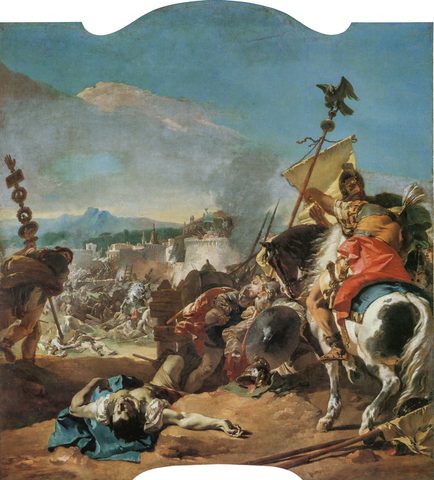
The Capture of Carthage
Giovanni Battista Tiepolo, 1725–29
146 BC: Scipio Aemilianus's legions storm Carthage and end Rome's great rival. One of the Ca' Dolfin canvases of Roman history.
About this work
A Roman commander in red rides a rearing white horse above a scene of battle in this painting by the Venetian artist Giovanni Battista Tiepolo, now in the Metropolitan Museum of Art. In 146 BC, the legions of Scipio Aemilianus took and destroyed Carthage, ending the long rivalry between Rome and the North African city. Standards and spears rise against a blue sky, fallen soldiers lie in the foreground, and smoke drifts over the distant hills.
The canvas comes from a series of Roman history scenes that Tiepolo painted for the Ca' Dolfin, a palace in Venice, early in his career. Its shaped top edge shows that it was made to fit the decoration of a room. Tiepolo went on to become the leading painter of 18th-century Venice and worked in Germany and Spain as well as Italy.
The scan is 2463 × 2724 pixels, suited to small and medium prints. It makes a fine gift for a lover of Venetian painting or Roman history.
Sources: Wikimedia Commons · Wikipedia: Giovanni Battista Tiepolo
FAQ
Where can I buy a framed print of The Capture of Carthage?
Here. The Capture of Carthage is available as a framed print in two sizes: Small (18 × 20 in) for $195 and Medium (22 × 24 in) for $295. Prices include the frame and US shipping; delivery takes 14–21 days, with 30-day returns.
What size works best for The Capture of Carthage?
The file is 2,463 × 2,724 px, so Small (18 × 20 in) is the sharpest choice at 136 ppi. Medium (22 × 24 in) prints at 112 ppi: fine from a few feet away, softer up close.
Is it legal to print The Capture of Carthage?
Yes. The Capture of Carthage is in the public domain: its copyright, if it ever had one, expired long ago. In the United States a faithful photograph of a public-domain painting does not create a new copyright (Bridgeman v. Corel, 1999), so the image can be printed and sold freely.

















