Vercingetorix Surrenders to Caesar
Henri-Paul Motte, 1886
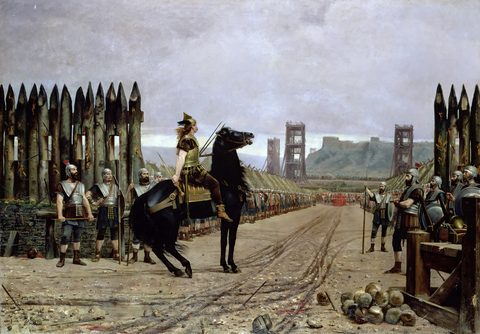
52 BC, after the siege of Alesia: the Gallic leader Vercingetorix rides out alone to the Roman siege works to give himself up to Caesar.
About this work
The Gallic leader Vercingetorix rides alone on a dark horse toward the Roman lines in this 1886 painting by the French artist Henri-Paul Motte, in the Musée Crozatier at Le Puy-en-Velay. In 52 BC, after the long siege of Alesia, he came out to surrender to Julius Caesar, ending the great Gallic revolt. Motte shows the moment from the Roman side: a road between rows of sharpened wooden stakes, watchtowers in the distance, and legionaries standing still as the rider approaches.
Motte was a Paris-born painter who specialized in historical subjects. His unusual, wide-open composition puts the long empty road and the defeated leader at its center, rather than the conqueror.
The scan is 2899 × 2019 pixels, suited to small and medium prints. It makes a striking gift for anyone with an interest in French history or the wars of Julius Caesar.
Sources: Wikimedia Commons · Wikipedia: Henri-Paul Motte
FAQ
Where can I buy a framed print of Vercingetorix Surrenders to Caesar?
Here. Vercingetorix Surrenders to Caesar is available as a framed print in two sizes: Small (20 × 14 in) for $195 and Medium (24 × 17 in) for $295. Prices include the frame and US shipping; delivery takes 14–21 days, with 30-day returns.
What size works best for Vercingetorix Surrenders to Caesar?
The file is 2,899 × 2,019 px, so Small (20 × 14 in) is the sharpest choice at 144 ppi. Medium (24 × 17 in) prints at 119 ppi: fine from a few feet away, softer up close.
Is it legal to print Vercingetorix Surrenders to Caesar?
Yes. Vercingetorix Surrenders to Caesar is in the public domain: its copyright, if it ever had one, expired long ago. In the United States a faithful photograph of a public-domain painting does not create a new copyright (Bridgeman v. Corel, 1999), so the image can be printed and sold freely.

















