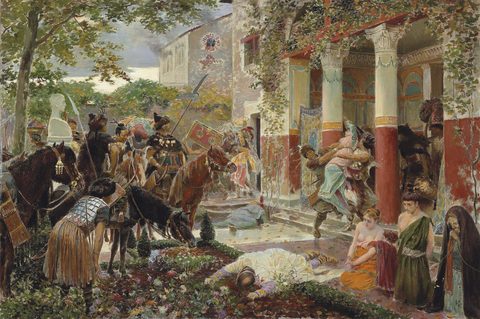
The Huns
Georges Rochegrosse, early 20th century
Attila's horsemen burst into a Roman villa in Gaul, wreck it and drag off its people. The end of Roman order in the West.
About this work
The Huns, also known by its French title Attila et les Huns, is an oil on canvas of 62.5 by 93.3 centimetres by the French painter Georges Rochegrosse. It is signed GRochegrosse at lower right and is in a private collection; it was sold at Christie's, and Wikimedia Commons dates it to before 1938, the year of the painter's death. The picture shows a Roman villa in Gaul being sacked by the horsemen of Attila, who break in, wreck the house and carry off its people. The Huns were a nomadic people who lived in Central Asia, the Caucasus and Eastern Europe between the fourth and sixth centuries. By 430 they had built a vast but short-lived empire on the Danube frontier of the Roman world, and under Attila they raided the Eastern Roman Empire repeatedly before invading the Western province of Gaul in 451. Rochegrosse was born in Versailles in 1859 and studied in Paris with Jules Joseph Lefebvre and Gustave Boulanger. He painted history on a colossal scale, in an emotional naturalistic style that revelled in violent detail. He made his Salon debut in 1882 with Vitellius Dragged through the Streets of Rome, and his Andromache won the Prix du Salon the following year.
Sources: Wikimedia Commons · Christie's lot record · Wikipedia: Georges Rochegrosse · Wikipedia: Huns
FAQ
Where can I buy a framed print of The Huns?
Here. The Huns is available as a framed print in two sizes: Small (20 × 13 in) for $195 and Medium (24 × 16 in) for $295. Prices include the frame and US shipping; delivery takes 14–21 days, with 30-day returns.
What size works best for The Huns?
The file is 3,200 × 2,127 px. Small (20 × 13 in) is the largest size that prints at 150 ppi or more (160 ppi), the sharpest choice for close viewing; Medium (24 × 16 in) prints at 133 ppi, fine from a few feet away but softer up close.
Is it legal to print The Huns?
Yes. The Huns is in the public domain: its copyright, if it ever had one, expired long ago. In the United States a faithful photograph of a public-domain painting does not create a new copyright (Bridgeman v. Corel, 1999), so the image can be printed and sold freely.

















