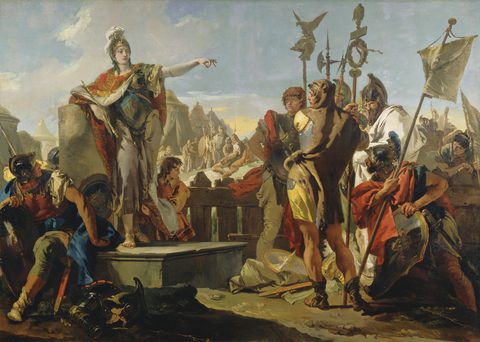
Queen Zenobia Addressing Her Soldiers
Giovanni Battista Tiepolo, 1725–1730
Zenobia stands above her soldiers and points the campaign forward.
About this work
Queen Zenobia of Palmyra, in a gold gown and ermine-trimmed cloak, stands on a raised step and addresses her armoured soldiers, pointing them toward the campaign ahead, in this canvas by Giovanni Battista Tiepolo from about 1725 to 1730. It is in the National Gallery of Art in Washington, part of the Samuel H. Kress Collection. The painting is thought to come from a series on Zenobia painted for the Zenobio family's palace in Venice, whose name echoed the queen's. Zenobia, born around 240, married Odaenathus, ruler of Palmyra in Syria, who made the city the leading power in the Roman East. After his assassination in 267 she ruled as regent for her son Vaballathus and conquered Egypt and much of Asia Minor, before the emperor Aurelian defeated her in 272 and took her to Rome. Her courage and learning made her a favourite heroine of later art. Tiepolo, born in Venice in 1696, was the greatest Venetian painter of the eighteenth century, famous for his luminous ceiling frescoes in Würzburg, Venice and Madrid, where he died in 1770.
Sources: Wikimedia Commons · Wikipedia: Zenobia · Wikipedia: Giovanni Battista Tiepolo
FAQ
Where can I buy a framed print of Queen Zenobia Addressing Her Soldiers?
Here. Queen Zenobia Addressing Her Soldiers is available as a framed print in two sizes: Small (20 × 14 in) for $195 and Medium (24 × 17 in) for $295. Prices include the frame and US shipping; delivery takes 14–21 days, with 30-day returns.
What size works best for Queen Zenobia Addressing Her Soldiers?
The file is 3,133 × 2,232 px. Small (20 × 14 in) is the largest size that prints at 150 ppi or more (157 ppi), the sharpest choice for close viewing; Medium (24 × 17 in) prints at 131 ppi, fine from a few feet away but softer up close.
Is it legal to print Queen Zenobia Addressing Her Soldiers?
Yes. The National Gallery of Art lists this painting as public domain and releases its image as open access, so it can be printed and sold freely. Tiepolo died in 1770.

















