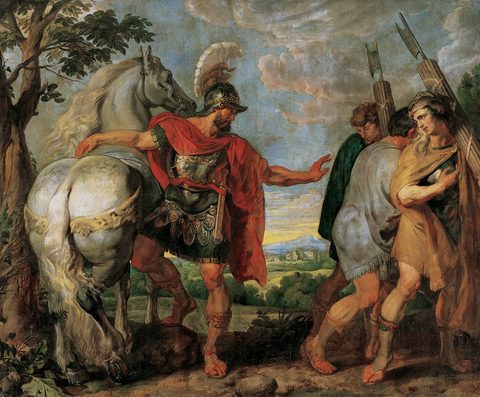
The Dismissal of the Lictors
Peter Paul Rubens, 1616–17
Decius Mus sends away his lictors, the guards of his office, before going into battle as a private soldier. From Rubens's Decius Mus cycle.
About this work
The Roman consul Decius Mus, in armor and a plumed helmet, stands beside a gray horse and gestures to his lictors in this painting by Peter Paul Rubens, made in 1616–17. The lictors were the attendants who carried the fasces, the bundles of rods that marked a magistrate's authority. Having vowed to die for Rome's victory, Decius sends them away and prepares to go into battle without the marks of his office. The lictors, carrying their fasces, turn to leave, and trees and a cloudy sky fill the background.
The scene belongs to Rubens's Decius Mus cycle, a series designing a set of tapestries on the consul's story, today in the Princely Collections of Liechtenstein in Vienna. Rubens's strong figures, rich reds and lively brushwork made him the leading painter of the Flemish Baroque.
The scan is 2500 × 2069 pixels, suited to small and medium prints. It makes a thoughtful gift for a lover of Rubens or of Roman history.
Sources: Wikimedia Commons · Wikipedia: Peter Paul Rubens
FAQ
Where can I buy a framed print of The Dismissal of the Lictors?
Here. The Dismissal of the Lictors is available as a framed print in two sizes: Small (20 × 17 in) for $195 and Medium (24 × 20 in) for $295. Prices include the frame and US shipping; delivery takes 14–21 days, with 30-day returns.
What size works best for The Dismissal of the Lictors?
The file is 2,500 × 2,069 px, so Small (20 × 17 in) is the sharpest choice at 122 ppi. Medium (24 × 20 in) prints at 103 ppi: fine from a few feet away, softer up close.
Is it legal to print The Dismissal of the Lictors?
Yes. The Dismissal of the Lictors is in the public domain: its copyright, if it ever had one, expired long ago. In the United States a faithful photograph of a public-domain painting does not create a new copyright (Bridgeman v. Corel, 1999), so the image can be printed and sold freely.

















