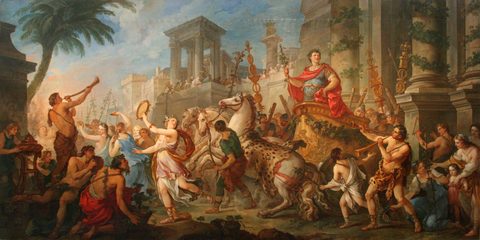
Mark Antony's Entry into Ephesus
Charles-Joseph Natoire, 18th century
Mark Antony enters Ephesus as the new Dionysus, with a procession of bacchants, musicians and soldiers around his chariot.
About this work
Mark Antony rides into the city of Ephesus in a triumphal procession in this painting by the French artist Charles-Joseph Natoire, dated 1741 on Wikimedia Commons. In the ancient account, Antony entered Ephesus in 41 BC hailed as the new Dionysus, god of wine, and Natoire fills the long, low canvas with dancing bacchants, musicians with horns and tambourines, soldiers and animals around his chariot, with temples and palm trees behind.
Natoire was a Rococo painter, a pupil of François Lemoyne, and was considered in his own lifetime the equal of François Boucher. From 1751 to 1775 he directed the French Academy in Rome, where generations of young French artists trained.
The scan is 3167 × 1582 pixels, a wide format suited to a small or medium print above a sideboard, a sofa or a bed. It makes a lively gift for anyone who loves Roman history, wine or the story of Antony and Cleopatra.
Sources: Wikimedia Commons · Wikipedia: Charles-Joseph Natoire
FAQ
Where can I buy a framed print of Mark Antony's Entry into Ephesus?
Here. Mark Antony's Entry into Ephesus is available as a framed print in two sizes: Small (20 × 10 in) for $195 and Medium (24 × 12 in) for $295. Prices include the frame and US shipping; delivery takes 14–21 days, with 30-day returns.
What size works best for Mark Antony's Entry into Ephesus?
The file is 3,167 × 1,582 px. Small (20 × 10 in) is the largest size that prints at 150 ppi or more (158 ppi), the sharpest choice for close viewing; Medium (24 × 12 in) prints at 132 ppi, fine from a few feet away but softer up close.
Is it legal to print Mark Antony's Entry into Ephesus?
Yes. Mark Antony's Entry into Ephesus is in the public domain: its copyright, if it ever had one, expired long ago. In the United States a faithful photograph of a public-domain painting does not create a new copyright (Bridgeman v. Corel, 1999), so the image can be printed and sold freely.

















