The Fire of Rome
Hubert Robert, 1785
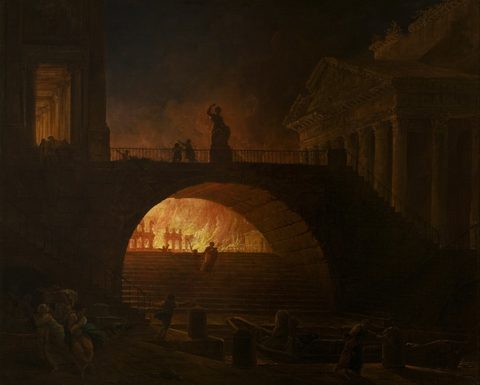
Rome burning at night, seen through the arch of a bridge. The fire turns the river and the temple steps orange while people in the foreground carry out what they can.
About this work
The Fire of Rome is an oil on canvas of 75.5 by 93 centimetres by Hubert Robert. It belongs to the MuMa, the Musée d'art moderne André Malraux in Le Havre, which bought it for the city. The museum's own record dates it to about 1771; it has also been dated to about 1785. Robert shows the great fire of AD 64 through the dark arch of a bridge: the flames behind it light up temple fronts and an ancient statue, and in the foreground women flee down the steps, one leading a child by the hand. The museum points out that only women are shown in flight, which heightens the drama, and that the statue above the mother and child sets the ancient world beside the human one. The Great Fire of Rome broke out on the night of 18 to 19 July AD 64 in the shops around the Circus Maximus and burned for six days, then flared up for three more; ten of the city's fourteen districts were destroyed. Robert, born in Paris in 1733, spent eleven years in Rome, from 1754 to 1765, where Panini and above all Piranesi turned him into a painter of architecture and ruins, nicknamed Robert des ruines. He died in Paris in 1808.
Sources: MuMa Le Havre · Wikipedia: Great Fire of Rome · Wikipedia: Hubert Robert
FAQ
Where can I buy a framed print of The Fire of Rome?
Here. The Fire of Rome is available as a framed print in two sizes: Small (20 × 16 in) for $195 and Medium (24 × 19 in) for $295. Prices include the frame and US shipping; delivery takes 14–21 days, with 30-day returns.
What size works best for The Fire of Rome?
The file is 3,108 × 2,497 px. Small (20 × 16 in) is the largest size that prints at 150 ppi or more (155 ppi), the sharpest choice for close viewing; Medium (24 × 19 in) prints at 130 ppi, fine from a few feet away but softer up close.
Is it legal to print The Fire of Rome?
Yes. The Fire of Rome is in the public domain: its copyright, if it ever had one, expired long ago. In the United States a faithful photograph of a public-domain painting does not create a new copyright (Bridgeman v. Corel, 1999), so the image can be printed and sold freely.
















