The Interpretation of the Victim
Peter Paul Rubens, 1616–17
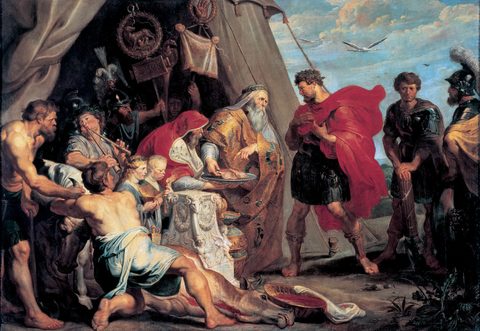
A priest reads the entrails of a sacrificed bull, and the omens confirm that Decius Mus must die. From Rubens's Decius Mus cycle.
About this work
A priest examines the entrails of a sacrificed animal while the Roman consul Decius Mus, in a red cloak, watches in this painting by Peter Paul Rubens, made in 1616–17. In the story told by Livy, the omens confirmed what Decius had dreamed: one army would lose its general, and the other the battle. Here an old priest in rich robes bends over the sacrifice in front of a tent, assistants kneel around it, and soldiers in helmets stand behind the consul.
The painting belongs to Rubens's Decius Mus cycle, a series designing a set of tapestries on the consul's story, now in the Princely Collections of Liechtenstein in Vienna. Rubens, the most influential artist of the Flemish Baroque, loved such scenes of ancient ritual and drama.
The scan is 2500 × 1722 pixels, suited to small and medium prints. It makes an unusual gift for a lover of Rubens or of the ancient world.
Sources: Wikimedia Commons · Wikipedia: Peter Paul Rubens
FAQ
Where can I buy a framed print of The Interpretation of the Victim?
Here. The Interpretation of the Victim is available as a framed print in two sizes: Small (20 × 14 in) for $195 and Medium (24 × 17 in) for $295. Prices include the frame and US shipping; delivery takes 14–21 days, with 30-day returns.
What size works best for The Interpretation of the Victim?
The file is 2,500 × 1,722 px, so Small (20 × 14 in) is the sharpest choice at 123 ppi. Medium (24 × 17 in) prints at 101 ppi: fine from a few feet away, softer up close.
Is it legal to print The Interpretation of the Victim?
Yes. The Interpretation of the Victim is in the public domain: its copyright, if it ever had one, expired long ago. In the United States a faithful photograph of a public-domain painting does not create a new copyright (Bridgeman v. Corel, 1999), so the image can be printed and sold freely.

















