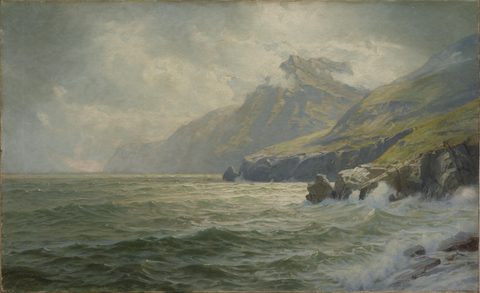
Donegal Bay
William Trost Richards, 1902
Atlantic surf rolls into Donegal Bay below green headlands.
About this work
William Trost Richards painted Donegal Bay in 1902, three years before his death. It shows Atlantic surf breaking along the coast of the bay below green headlands. The oil on canvas, about 56 by 91 centimetres, belongs to the Dallas Museum of Art (1903.3), the gift of Mrs. Alfred H. Belo. Donegal Bay, in the northwest of Ireland, is the country's largest bay. It is bounded by the coasts of Counties Donegal, Leitrim and Sligo and open to the Atlantic on the west. Its funnel shape and west-facing position bring in the big Atlantic swells that now make its beaches famous for surfing. On its shores are the sea cliffs of Slieve League, which rise about 600 metres above the water. Richards was born in Philadelphia in 1833 and trained there while working as a designer of ornamental metalwork. He was associated with the Hudson River School and with the American Pre-Raphaelites, who called for truth to nature. He rejected the romantic stylisation of many of his contemporaries in favour of meticulous, factual rendering, and in his later years he painted the sea almost exclusively. From 1881 he lived and worked in Jamestown, Rhode Island, and he died in Newport in 1905.
Sources: Dallas Museum of Art · Wikimedia Commons · Wikipedia: William Trost Richards · Wikipedia: Donegal Bay
FAQ
Where can I buy a framed print of Donegal Bay?
Here. Donegal Bay is available as a framed print in three sizes: Small (20 × 12 in) for $195, Medium (24 × 15 in) for $295 and Large (36 × 22 in) for $395. Prices include the frame and US shipping; delivery takes 14–21 days, with 30-day returns.
What size works best for Donegal Bay?
The file is 9,728 × 5,944 px, so every size is sharp: even Large (36 × 22 in) prints at 270 ppi. Choose Large (36 × 22 in) for a large wall; Small (20 × 12 in) suits a narrower space.
Is it legal to print Donegal Bay?
Yes. Donegal Bay is in the public domain: its copyright, if it ever had one, expired long ago. In the United States a faithful photograph of a public-domain painting does not create a new copyright (Bridgeman v. Corel, 1999), so the image can be printed and sold freely.

















