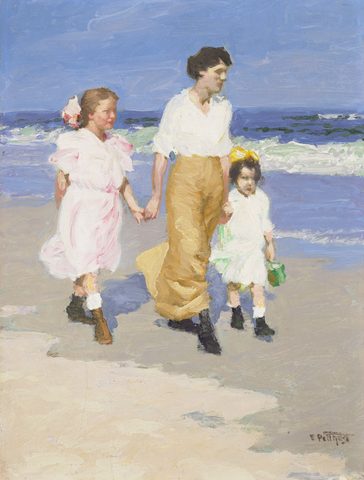
On the Beach
Edward Henry Potthast, c. 1915
Figures stand in the light like flags. Sand, sea, and the easy hour between tides.
About this work
On the Beach is a small oil on panel, 16 by 12 inches, by the American Impressionist Edward Henry Potthast, signed E Potthast at lower right. A young woman in a white blouse and long skirt walks barefoot across the sand holding hands with two little girls in white dresses and bonnets, while green and blue waves break behind them under a bright sky. It was sold at Christie's in New York on 18 May 2021 for 43,750 dollars. It had belonged to Mr. and Mrs. J.C. Haefelin of Wynnewood, Pennsylvania, and was sold at Sotheby's in New York in 1989, and it was shown in The Art of Edward Henry Potthast at the Evansville Museum of Arts and Science in Indiana in 1975. Potthast was born in Cincinnati in 1857 and worked for years as a lithographer while studying art at the McMicken School, then in Munich and in Paris under Fernand Cormon. He moved to New York in 1895 and worked as a magazine illustrator. From about 1908, from a studio in the Gainsborough Building, he painted the sunny scenes of Central Park, New England and the Long Island beaches for which he is best remembered. He died in New York in 1927.
Sources: Christie's · Wikipedia: Edward Henry Potthast
FAQ
Where can I buy a framed print of On the Beach?
Here. On the Beach is available as a framed print in two sizes: Small (15 × 20 in) for $195 and Medium (18 × 24 in) for $295. Prices include the frame and US shipping; delivery takes 14–21 days, with 30-day returns.
What size works best for On the Beach?
The file is 2,426 × 3,200 px. Small (15 × 20 in) is the largest size that prints at 150 ppi or more (160 ppi), the sharpest choice for close viewing; Medium (18 × 24 in) prints at 133 ppi, fine from a few feet away but softer up close.
Is it legal to print On the Beach?
Yes. On the Beach is in the public domain: its copyright, if it ever had one, expired long ago. In the United States a faithful photograph of a public-domain painting does not create a new copyright (Bridgeman v. Corel, 1999), so the image can be printed and sold freely.
















