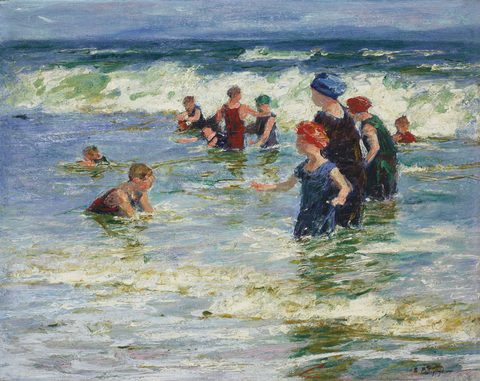
Beach Scene
Edward Henry Potthast, c. 1915
Children and mothers under a bright sky. The Atlantic is a playground. He painted joy without apology.
About this work
Beach Scene is an oil on canvas of 16 by 20 inches by the American Impressionist Edward Henry Potthast, signed E Potthast at lower right. Children wade and splash in the shallow green surf, a woman in a dark bathing dress and red cap leads them through the waves, and white breakers roll in behind under a bright sky. It was sold at Christie's in New York on 17 May 2022 for 126,000 dollars, as property from the collection of Robert and Virginia Payne. Its recorded history includes the Spanierman Gallery in New York and Taggart, Jorgensen and Putman in Washington, D.C., from whom the Paynes acquired it in 1990. Potthast was born in Cincinnati in 1857 and worked for years as a lithographer at the Strobridge Lithography Company while he studied at the McMicken School. He trained further at the Royal Academy in Munich and in Paris under Fernand Cormon, then moved to New York in 1895 and worked as a magazine illustrator. By 1908 he had a studio in the Gainsborough Building, and from then on he painted the sunlit scenes of Central Park and of the Long Island and New England beaches for which he is best known.
Sources: Christie's · Wikipedia: Edward Henry Potthast
FAQ
Where can I buy a framed print of Beach Scene?
Here. Beach Scene is available as a framed print in two sizes: Small (20 × 16 in) for $195 and Medium (24 × 19 in) for $295. Prices include the frame and US shipping; delivery takes 14–21 days, with 30-day returns.
What size works best for Beach Scene?
The file is 3,200 × 2,542 px. Small (20 × 16 in) is the largest size that prints at 150 ppi or more (159 ppi), the sharpest choice for close viewing; Medium (24 × 19 in) prints at 133 ppi, fine from a few feet away but softer up close.
Is it legal to print Beach Scene?
Yes. Beach Scene is in the public domain: its copyright, if it ever had one, expired long ago. In the United States a faithful photograph of a public-domain painting does not create a new copyright (Bridgeman v. Corel, 1999), so the image can be printed and sold freely.
















