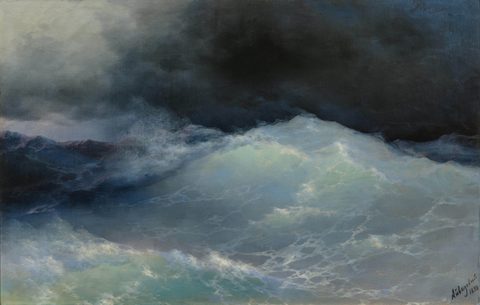
Swell on the High Sea
Ivan Aivazovsky, 1898
Aivazovsky late in life — green swells rolling under a breaking sky, nothing but open water.
About this work
Swell on the High Sea is an oil on canvas of 61 by 93.5 centimetres painted by Ivan Aivazovsky in 1898, two years before his death. It is signed and dated in Cyrillic at lower right and again on the back, and it was sold by the Swiss auction house Koller as Wellengang auf hoher See. There is no ship, no coast and no figure in it: only a long green swell breaking into foam under a dark storm sky, with light from the left catching the crests. The sea alone was the subject Aivazovsky returned to most. His best-known painting, The Ninth Wave of 1850, is a storm scene, and most scholars think it marks the turn from the fantastic colour of his early work to the more truthful vision of his later years. By the 1870s his paintings were dominated by delicate colours. Aivazovsky was born to Armenian parents in Feodosia in Crimea in 1817 and lived there for most of his life. He trained at the Imperial Academy of Arts in Saint Petersburg, became the main painter of the Russian Navy, and made about 6,000 paintings, most of them seascapes. He died in Feodosia in 1900.
Sources: Wikimedia Commons · Wikipedia: Ivan Aivazovsky
FAQ
Where can I buy a framed print of Swell on the High Sea?
Here. Swell on the High Sea is available as a framed print in three sizes: Small (20 × 13 in) for $195, Medium (24 × 15 in) for $295 and Large (36 × 23 in) for $395. Prices include the frame and US shipping; delivery takes 14–21 days, with 30-day returns.
What size works best for Swell on the High Sea?
The file is 8,083 × 5,132 px, so every size is sharp: even Large (36 × 23 in) prints at 223 ppi. Choose Large (36 × 23 in) for a large wall; Small (20 × 13 in) suits a narrower space.
Is it legal to print Swell on the High Sea?
Yes. Swell on the High Sea is in the public domain: its copyright, if it ever had one, expired long ago. In the United States a faithful photograph of a public-domain painting does not create a new copyright (Bridgeman v. Corel, 1999), so the image can be printed and sold freely.

















