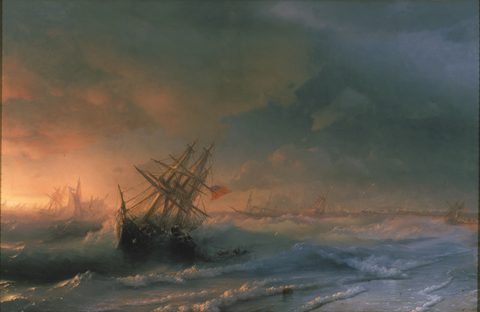
Storm over Yevpatoria
Ivan Aivazovsky, 1861
A black bow and a red flag. The sky is torn. The other ships are only masts.
About this work
Storm over Yevpatoria is an oil on canvas painted by Ivan Aivazovsky in 1861. It belongs to the Tsarskoye Selo State Museum-Reserve near Saint Petersburg. A dark-hulled ship flying a red flag pitches in a heavy sea under a torn sky, while other vessels in the distance are reduced to bare masts. Yevpatoria is a city in western Crimea, on Kalamita Bay. Greek colonists founded the first settlement there, Kerkinitis, around 500 BC, and the modern name comes from the nickname of King Mithridates VI Eupator, whose kingdom included the town. Later it was a Khazar settlement and, under the Crimean Khanate, the port of Kezlev. Aivazovsky was born Hovhannes Aivazian in 1817 in Feodosia, another Crimean port, to Armenian parents. He studied at the Imperial Academy of Arts in Saint Petersburg, lived briefly in Italy, and became the main painter of the Russian Navy, close to the elite of the Russian Empire. He is considered one of the greatest masters of marine art, and he spent most of his life on the Black Sea coast he painted.
Sources: Tsarskoye Selo Museum-Reserve · Wikipedia: Ivan Aivazovsky · Wikipedia: Yevpatoria
FAQ
Where can I buy a framed print of Storm over Yevpatoria?
Here. Storm over Yevpatoria is available as a framed print in two sizes: Small (20 × 13 in) for $195 and Medium (24 × 16 in) for $295. Prices include the frame and US shipping; delivery takes 14–21 days, with 30-day returns.
What size works best for Storm over Yevpatoria?
The file is 3,420 × 2,224 px. Small (20 × 13 in) is the largest size that prints at 150 ppi or more (171 ppi), the sharpest choice for close viewing; Medium (24 × 16 in) prints at 139 ppi, fine from a few feet away but softer up close.
Is it legal to print Storm over Yevpatoria?
Yes. Storm over Yevpatoria is in the public domain: its copyright, if it ever had one, expired long ago. In the United States a faithful photograph of a public-domain painting does not create a new copyright (Bridgeman v. Corel, 1999), so the image can be printed and sold freely.
















