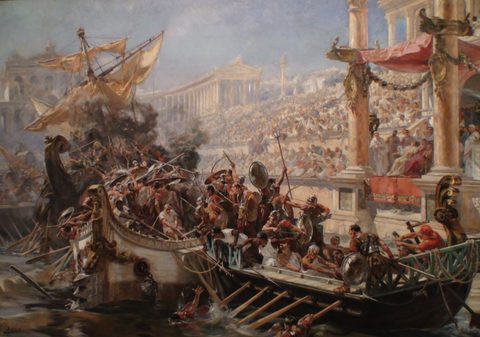
The Naumachia
Ulpiano Checa, c. 1894
Staged Roman naval battle — Checa's arena spectacle of empire.
About this work
Ulpiano Checa painted The Naumachia, a staged naval battle between Romans, in 1894. It was shown that year at the Salon of the Société Nationale des Beaux-Arts in Paris and won a gold medal at the International Exposition in Atlanta in 1895. The painting is now in the Museo Ulpiano Checa in Colmenar de Oreja, the town near Madrid where the artist was born in 1860 and where he is buried. A naumachia was a mock sea battle put on as mass entertainment in ancient Rome, usually in a specially dug basin. Julius Caesar staged the first known one in 46 BC with 2,000 combatants and 4,000 rowers, all prisoners of war. Augustus followed with a larger one in 2 BC, Claudius held one on the Fucine Lake in 52 AD, and Titus gave two for the opening of the Colosseum in 80 AD. Checa trained in Madrid and Rome, settled in Paris in 1889 and became internationally known for scenes of ancient history; a chariot race won him third prize at the Paris Salon in 1890.
Sources: Wikimedia Commons · Wikipedia: Ulpiano Checa · Wikipedia: Naumachia
FAQ
Where can I buy a framed print of The Naumachia?
Here. The Naumachia is available as a framed print in three sizes: Small (20 × 14 in) for $195, Medium (24 × 17 in) for $295 and Large (36 × 25 in) for $395. Prices include the frame and US shipping; delivery takes 14–21 days, with 30-day returns.
What size works best for The Naumachia?
The file is 3,653 × 2,563 px. Medium (24 × 17 in) is the largest size that prints at 150 ppi or more (151 ppi), the sharpest choice for close viewing; Large (36 × 25 in) prints at 101 ppi, fine from a few feet away but softer up close.
Is it legal to print The Naumachia?
Yes. The Naumachia is in the public domain: its copyright, if it ever had one, expired long ago. In the United States a faithful photograph of a public-domain painting does not create a new copyright (Bridgeman v. Corel, 1999), so the image can be printed and sold freely.

















