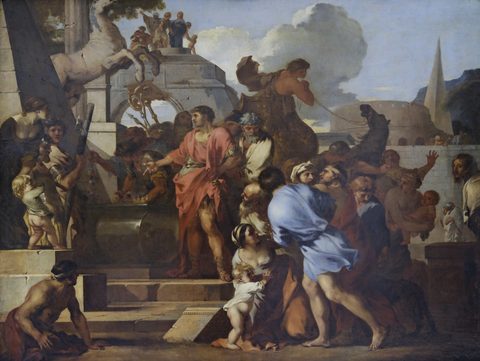
Augustus at the Tomb of Alexander
Sébastien Bourdon, c. 1643
Augustus has Alexander the Great's sarcophagus opened in Alexandria. Soldiers and priests crowd the steps as the new master of the Roman world looks on the conqueror he means to outdo.
About this work
Augustus, the first Roman emperor, stands before the opened tomb of Alexander the Great in this painting by the French artist Sébastien Bourdon, now in the Musée du Louvre. The scene is set in Alexandria. Soldiers, priests and onlookers crowd the steps around the sarcophagus, and classical buildings and a pale sky open up behind them. The new master of the Roman world looks on the body of the conqueror whose fame he meant to equal.
Bourdon was a French painter and engraver whose best-known work is The Crucifixion of St. Peter, painted for Notre-Dame in Paris. Like many painters of his generation, he drew on ancient history for grand, crowded compositions full of gesture and architecture.
The scan is 10065 × 7582 pixels, so the painting can be printed large with every face and fold intact. It suits a library, a study or a dining room, and makes a fine gift for anyone who loves ancient history or the story of Alexander.
Sources: Wikimedia Commons · Wikipedia: Sébastien Bourdon
FAQ
Where can I buy a framed print of Augustus at the Tomb of Alexander?
Here. Augustus at the Tomb of Alexander is available as a framed print in three sizes: Small (20 × 15 in) for $195, Medium (24 × 18 in) for $295 and Large (36 × 27 in) for $395. Prices include the frame and US shipping; delivery takes 14–21 days, with 30-day returns.
What size works best for Augustus at the Tomb of Alexander?
The file is 10,065 × 7,582 px, so every size is sharp: even Large (36 × 27 in) prints at 280 ppi. Choose Large (36 × 27 in) for a large wall; Small (20 × 15 in) suits a narrower space.
Is it legal to print Augustus at the Tomb of Alexander?
Yes. Augustus at the Tomb of Alexander is in the public domain: its copyright, if it ever had one, expired long ago. In the United States a faithful photograph of a public-domain painting does not create a new copyright (Bridgeman v. Corel, 1999), so the image can be printed and sold freely.

















