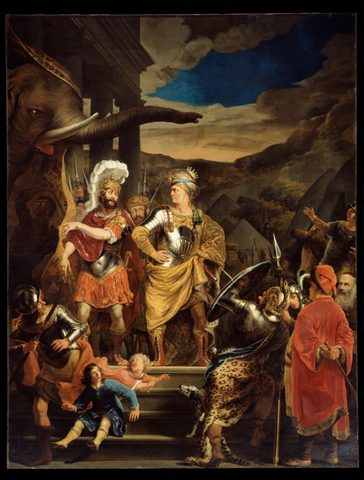
Fabricius and Pyrrhus
Ferdinand Bol, 1656
Fabricius refuses Pyrrhus's gifts, the old Roman test of a man who cannot be bought.
About this work
The Roman consul Gaius Fabricius stands unmoved in the camp of King Pyrrhus in this 1656 painting by the Dutch artist Ferdinand Bol, made for the town hall of Amsterdam, now the Royal Palace. In the old story, Pyrrhus first tried to buy Fabricius with gold and then to frighten him with an elephant, and neither worked. Bol fills the tall canvas with armored figures, rich fabrics and a dark sky, with the calm Roman at the center of the drama.
Bol was a pupil of Rembrandt, and like his master he favored historical subjects, portraits and figures in rich, exotic dress. The theme of an incorruptible public servant suited a painting for the city's seat of government.
The scan is 5665 × 7471 pixels, a strong file for a tall print. It works in an office, a hallway or a library, and makes a thoughtful gift for a lawyer, a public servant or a lover of Roman history.
Sources: Wikimedia Commons · Wikipedia: Ferdinand Bol
FAQ
Where can I buy a framed print of Fabricius and Pyrrhus?
Here. Fabricius and Pyrrhus is available as a framed print in three sizes: Small (15 × 20 in) for $195, Medium (18 × 24 in) for $295 and Large (27 × 36 in) for $395. Prices include the frame and US shipping; delivery takes 14–21 days, with 30-day returns.
What size works best for Fabricius and Pyrrhus?
The file is 5,665 × 7,471 px, so every size is sharp: even Large (27 × 36 in) prints at 208 ppi. Choose Large (27 × 36 in) for a large wall; Small (15 × 20 in) suits a narrower space.
Is it legal to print Fabricius and Pyrrhus?
Yes. Fabricius and Pyrrhus is in the public domain: its copyright, if it ever had one, expired long ago. In the United States a faithful photograph of a public-domain painting does not create a new copyright (Bridgeman v. Corel, 1999), so the image can be printed and sold freely.

















