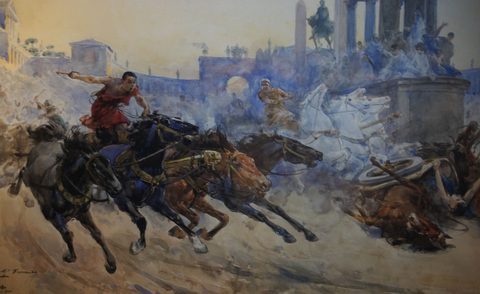
Roman Chariot Race
Ulpiano Checa, c. 1890s
Chariots tear around the Circus — Actium-class speed and crowd roar.
About this work
Chariots drawn by teams of galloping horses tear around the turning post of a Roman circus, their drivers leaning into the curve as dust flies and the crowd roars from the stands, in Roman Chariot Race by the Spanish painter Ulpiano Checa. The Commons record dates the work to 1890, the year Checa made his name in Paris with a celebrated chariot race painting, and he returned to the subject several times. Chariot racing, the ludi circenses, was the most popular spectacle in ancient Rome. Four factions, the Reds, Whites, Greens and Blues, competed in the Circus Maximus before as many as 150,000 spectators, and star charioteers became rich and famous. Races of seven laps were fast and dangerous, with crashes at the turns, known as naufragia or shipwrecks, a constant risk. Checa, born in Colmenar de Oreja near Madrid in 1860, trained at the Royal Academy of Fine Arts of San Fernando and settled in Paris. He specialised in dramatic scenes of ancient Rome, combining academic precision with a loose, energetic brushwork, and also worked as a sculptor, poster designer and illustrator. His paintings influenced the look of early films such as Ben-Hur. He died in 1916.
Sources: Wikimedia Commons · Wikipedia: Ulpiano Checa · Wikipedia: Chariot racing
FAQ
Where can I buy a framed print of Roman Chariot Race?
Here. Roman Chariot Race is available as a framed print in three sizes: Small (20 × 12 in) for $195, Medium (24 × 15 in) for $295 and Large (36 × 22 in) for $395. Prices include the frame and US shipping; delivery takes 14–21 days, with 30-day returns.
What size works best for Roman Chariot Race?
The file is 4,592 × 2,812 px. Medium (24 × 15 in) is the largest size that prints at 150 ppi or more (187 ppi), the sharpest choice for close viewing; Large (36 × 22 in) prints at 128 ppi, fine from a few feet away but softer up close.
Is it legal to print Roman Chariot Race?
Yes. This work is in the public domain: Ulpiano Checa died in 1916, so its copyright expired long ago. In the United States a faithful photograph of a public-domain painting does not create a new copyright (Bridgeman v. Corel, 1999), so the image can be printed and sold freely.

















