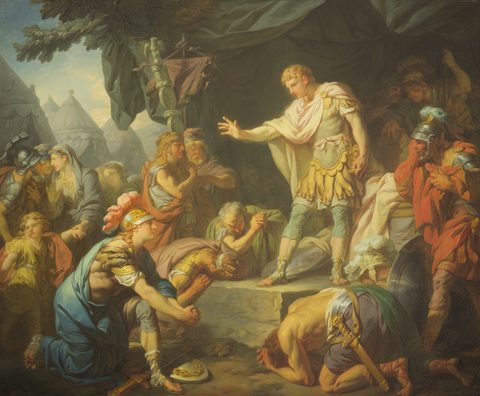
Germanicus Quelling the Mutiny in His Camp
François-André Vincent, 1795
AD 14: the Rhine legions mutiny after Augustus dies. Germanicus faces his own soldiers in the camp and talks them back into line.
About this work
The Roman general Germanicus confronts his own rebellious soldiers in this painting by the French Neoclassical artist François-André Vincent. In AD 14, after the death of the emperor Augustus, the legions on the Rhine mutinied, and Germanicus faced them in their camp and brought them back into line. Here he stands on a raised step in a gold breastplate, one hand stretched out, while soldiers kneel, plead and argue around him under the shade of a tree.
Vincent painted the canvas in 1768 for a competition. It won first prize at the Académie royale and the Prix de Rome that year, and at the artist's wish it went to the École nationale supérieure des beaux-arts in Paris. Our catalog lists the painting as 1795 in Lyon; the 1768 date and Paris location here follow Wikipedia and Wikimedia Commons.
The scan is 3802 × 3140 pixels. The painting makes a fine gift for a leader, a teacher or anyone who admires the art of persuasion.
Sources: Wikimedia Commons · Wikipedia: François-André Vincent
FAQ
Where can I buy a framed print of Germanicus Quelling the Mutiny in His Camp?
Here. Germanicus Quelling the Mutiny in His Camp is available as a framed print in three sizes: Small (20 × 17 in) for $195, Medium (24 × 20 in) for $295 and Large (36 × 30 in) for $395. Prices include the frame and US shipping; delivery takes 14–21 days, with 30-day returns.
What size works best for Germanicus Quelling the Mutiny in His Camp?
The file is 3,802 × 3,140 px. Medium (24 × 20 in) is the largest size that prints at 150 ppi or more (157 ppi), the sharpest choice for close viewing; Large (36 × 30 in) prints at 105 ppi, fine from a few feet away but softer up close.
Is it legal to print Germanicus Quelling the Mutiny in His Camp?
Yes. Germanicus Quelling the Mutiny in His Camp is in the public domain: its copyright, if it ever had one, expired long ago. In the United States a faithful photograph of a public-domain painting does not create a new copyright (Bridgeman v. Corel, 1999), so the image can be printed and sold freely.

















