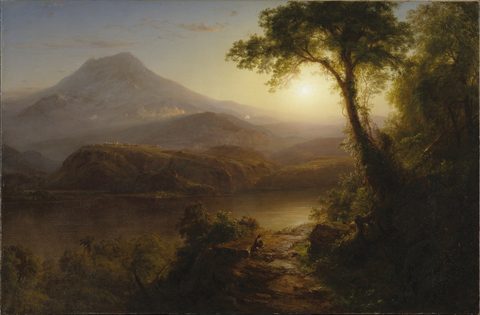
Tropical Scenery
Frederic Edwin Church, 1873
The sun sits in the tree. A lake goes back to a town on a ridge, and a mountain past that.
About this work
In Tropical Scenery, painted in 1873, Frederic Edwin Church looks from a shaded bank across a still lake toward a small town on a ridge and a distant mountain, while the sun burns through the branches of a tall tree. The painting is in the Brooklyn Museum (63.150). It is an imagined landscape built from memory and sketches rather than a single real place. Church had travelled in Colombia and Ecuador in 1853 and again in 1857, following in the footsteps of the naturalist Alexander von Humboldt, who urged artists to paint the tropics, and he went to Jamaica in 1865. For the rest of his career he drew on his South American studies for paintings that combined scientific detail of plants, rocks and atmosphere with glowing, theatrical light. Church, born in Hartford, Connecticut, in 1826, trained with Thomas Cole and became the leading painter of the second generation of the Hudson River School. Works such as The Heart of the Andes (1859) made him the most famous American painter of his day. In the 1870s he was building Olana, his house above the Hudson, and rheumatism later limited his painting.
Sources: Brooklyn Museum · Wikipedia: Frederic Edwin Church
FAQ
Where can I buy a framed print of Tropical Scenery?
Here. Tropical Scenery is available as a framed print in three sizes: Small (20 × 13 in) for $195, Medium (24 × 16 in) for $295 and Large (36 × 24 in) for $395. Prices include the frame and US shipping; delivery takes 14–21 days, with 30-day returns.
What size works best for Tropical Scenery?
The file is 5,729 × 3,763 px, so every size is sharp: even Large (36 × 24 in) prints at 157 ppi. Choose Large (36 × 24 in) for a large wall; Small (20 × 13 in) suits a narrower space.
Is it legal to print Tropical Scenery?
Yes. Tropical Scenery is in the public domain: Frederic Edwin Church died in 1900, so its copyright expired long ago. In the United States a faithful photograph of a public-domain painting does not create a new copyright (Bridgeman v. Corel, 1999), so the image can be printed and sold freely.
















