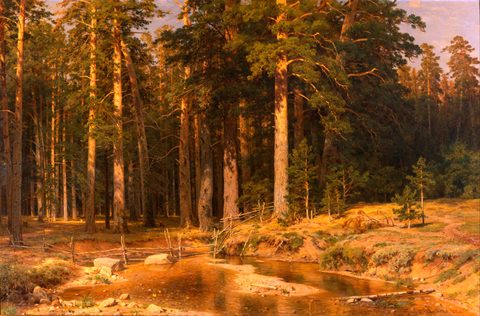
Mast-Tree Grove
Ivan Shishkin, 1898
Tall Russian pines glow red-gold in the afternoon sun over a forest stream.
About this work
Tall pines glow red-gold in the afternoon sun above a shallow forest stream in Mast-Tree Grove, painted by Ivan Shishkin in 1898, the last year of his life. It is in the State Russian Museum in Saint Petersburg. The title refers to the straight, towering pines prized for ships' masts, and the picture is one of the last of the many pine forests that made Shishkin famous. He is said to have died at his easel in March 1898 while working on another painting. Shishkin was born in 1832 in Yelabuga, in today's Tatarstan, into a merchant family. He studied in Moscow and at the Imperial Academy of Arts in Saint Petersburg, then in Germany and Switzerland, and became the foremost Russian painter of the forest. He was among the founding members of the Peredvizhniki, the Wanderers, a group of Realist artists who broke from the Academy to show their work in travelling exhibitions across Russia. His painstaking accuracy in drawing trees earned him the nickname of the forest's portraitist. His most familiar work, Morning in a Pine Forest, painted with Konstantin Savitsky, appeared on a popular Russian chocolate wrapper.
Sources: Wikimedia Commons · Wikipedia: Ivan Shishkin · Wikipedia: Russian Museum
FAQ
Where can I buy a framed print of Mast-Tree Grove?
Here. Mast-Tree Grove is available as a framed print in three sizes: Small (20 × 13 in) for $195, Medium (24 × 16 in) for $295 and Large (36 × 24 in) for $395. Prices include the frame and US shipping; delivery takes 14–21 days, with 30-day returns.
What size works best for Mast-Tree Grove?
The file is 4,624 × 3,041 px. Medium (24 × 16 in) is the largest size that prints at 150 ppi or more (190 ppi), the sharpest choice for close viewing; Large (36 × 24 in) prints at 127 ppi, fine from a few feet away but softer up close.
Is it legal to print Mast-Tree Grove?
Yes. Mast-Tree Grove is in the public domain: Ivan Shishkin died in 1898, so its copyright expired long ago. In the United States a faithful photograph of a public-domain painting does not create a new copyright (Bridgeman v. Corel, 1999), so the image can be printed and sold freely.

















