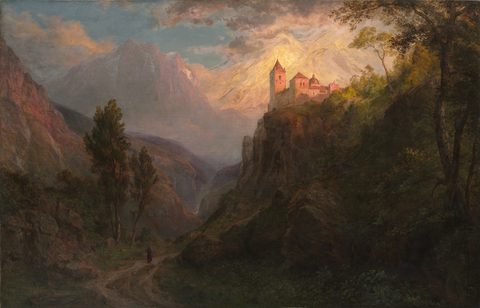
The Monastery of San Pedro (Our Lady of the Snows)
Frederic Edwin Church, 1873
Andes monastery under snow peaks. Church light on stone.
About this work
Frederic Edwin Church painted The Monastery of San Pedro (Our Lady of the Snows) in 1879. The oil on canvas, 118.8 by 183.2 centimetres, is in the Cleveland Museum of Art (1915.684). It was commissioned by Hinman B. Hurlbut, a Cleveland banker and railroad executive who was among the museum's founders, and it is recorded in his collection in 1880. The place that inspired it has been debated by scholars, but many believe it derives from Church's travels through the Ecuadorean Andes nearly a quarter of a century earlier. The museum reads the composition as an allegory of spiritual salvation: a brilliantly backlit monastery stands on a dramatic cliff above a shadowed foreground, where a lone figure picks a way along a rugged path. Church, born in Hartford, Connecticut, in 1826, was a central figure in the Hudson River School, known for huge landscapes of mountains, waterfalls and sunsets with realistic detail and dramatic light. In his prime he was one of the most famous painters in the United States.
Sources: Cleveland Museum of Art · Wikipedia: Frederic Edwin Church
FAQ
Where can I buy a framed print of The Monastery of San Pedro (Our Lady of the Snows)?
Here. The Monastery of San Pedro (Our Lady of the Snows) is available as a framed print in three sizes: Small (20 × 13 in) for $195, Medium (24 × 15 in) for $295 and Large (36 × 23 in) for $395. Prices include the frame and US shipping; delivery takes 14–21 days, with 30-day returns.
What size works best for The Monastery of San Pedro (Our Lady of the Snows)?
The file is 6,400 × 4,115 px, so every size is sharp: even Large (36 × 23 in) prints at 178 ppi. Choose Large (36 × 23 in) for a large wall; Small (20 × 13 in) suits a narrower space.
Is it legal to print The Monastery of San Pedro (Our Lady of the Snows)?
Yes. The Monastery of San Pedro (Our Lady of the Snows) is in the public domain: its copyright, if it ever had one, expired long ago. In the United States a faithful photograph of a public-domain painting does not create a new copyright (Bridgeman v. Corel, 1999), so the image can be printed and sold freely.
















