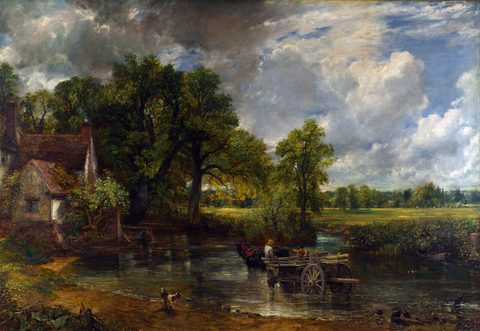
The Hay Wain
John Constable, 1821
A wagon crosses a Suffolk river like it does every day. A backyard that made England cry. No hero. No ruin. Just the place he could not leave.
About this work
The Hay Wain, completed in 1821, is John Constable's most famous image and one of the best-loved English paintings. It was first exhibited as Landscape: Noon. Three horses pull a large farm wagon across the River Stour near Flatford Mill in Suffolk, a mill owned by Constable's father; because the Stour is the county boundary, the left bank is in Suffolk and the right bank in Essex. On the left is the cottage of Willy Lott, a tenant farmer said to have been born there and never to have left it for more than four days. The canvas is one of Constable's "six-footers", the large pictures he painted for the Royal Academy's summer exhibitions, and like the others it began as a full-scale oil sketch, now in the Victoria and Albert Museum; a smaller sketch is at the Yale Center for British Art. It is regarded as a quintessential Romantic landscape. The painting measures 130.2 × 185.4 cm (51¼ × 73 in) and hangs in the National Gallery, London.
Sources: Wikipedia · The National Gallery, London
Print facts
- Native resolution
- 6,128 × 4,226 px
- Sharp at 150 ppi up to
- 40 × 28 in
- Sizes
- Small (20 × 14 in) · $100 · 302 ppi
Medium (24 × 17 in) · $150 · 249 ppi
Large (36 × 25 in) · $300 · 169 ppi - Price includes
- Frame and US shipping · 14–21 days · 30-day returns
FAQ
Where can I buy a framed print of The Hay Wain?
Here. The Hay Wain is available as a framed print in three sizes: Small (20 × 14 in) for $100, Medium (24 × 17 in) for $150 and Large (36 × 25 in) for $300. Prices include the frame and US shipping; delivery takes 14–21 days, with 30-day returns.
What size works best for The Hay Wain?
The file is 6,128 × 4,226 px, so every size is sharp: even Large (36 × 25 in) prints at 169 ppi. Choose Large (36 × 25 in) for a large wall; Small (20 × 14 in) suits a narrower space.
Is it legal to print The Hay Wain?
Yes. The Hay Wain is in the public domain: its copyright, if it ever had one, expired long ago. In the United States a faithful photograph of a public-domain painting does not create a new copyright (Bridgeman v. Corel, 1999), so the image can be printed and sold freely.