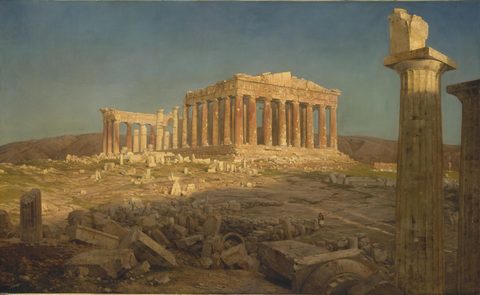
The Parthenon
Frederic Edwin Church, 1871
Broken white against a hard blue. Tourists are not in the picture. The ruin is enough.
About this work
Frederic Edwin Church painted The Parthenon in 1871. He had visited Athens in April 1869, at the end of a long journey through Europe and the Near East, and the Parthenon impressed him so much that he sketched and painted it energetically during his two weeks there. Those studies became the basis for the large canvas, which Church called his "big Parthenon"; he was able to start it in 1871 thanks to a commission from the financier and philanthropist Morris K. Jesup. The temple, dedicated to the goddess Athena on the Athenian Acropolis, was begun in 447 BC and completed in 438 BC, after the Greek victory over the Persian invaders. It later became a church and then a mosque. In 1687, during a Venetian siege, a bomb hit the building, which the Ottomans were using to store gunpowder, and the explosion severely damaged it. The Metropolitan Museum of Art received it in 1914 under the bequest of Jesup's widow, Maria DeWitt Jesup; it measures 44½ × 72⅝ inches.
Sources: Wikipedia · The Metropolitan Museum of Art · Wikipedia: Parthenon
Print facts
- Native resolution
- 5,898 × 3,627 px
- Sharp at 150 ppi up to
- 39 × 24 in
- Sizes
- Small (20 × 12 in) · $100 · 295 ppi
Medium (24 × 15 in) · $150 · 242 ppi
Large (36 × 22 in) · $300 · 164 ppi - Price includes
- Frame and US shipping · 14–21 days · 30-day returns
FAQ
Where can I buy a framed print of The Parthenon?
Here. The Parthenon is available as a framed print in three sizes: Small (20 × 12 in) for $100, Medium (24 × 15 in) for $150 and Large (36 × 22 in) for $300. Prices include the frame and US shipping; delivery takes 14–21 days, with 30-day returns.
What size works best for The Parthenon?
The file is 5,898 × 3,627 px, so every size is sharp: even Large (36 × 22 in) prints at 164 ppi. Choose Large (36 × 22 in) for a large wall; Small (20 × 12 in) suits a narrower space.
Is it legal to print The Parthenon?
Yes. The Parthenon is in the public domain: its copyright, if it ever had one, expired long ago. In the United States a faithful photograph of a public-domain painting does not create a new copyright (Bridgeman v. Corel, 1999), so the image can be printed and sold freely.