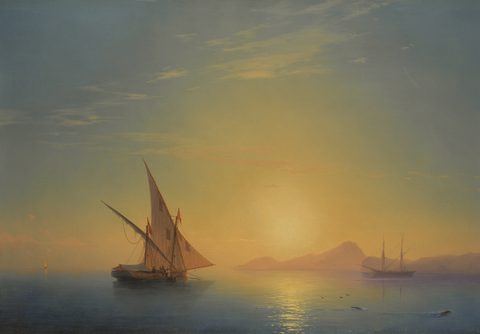
The Island of Ischia at Sunset
Ivan Aivazovsky, c. 1850s
A sailboat under a soft gold sun. The sea is a mirror. Ischia fades into haze. The day ends quietly.
About this work
Ivan Aivazovsky painted The Island of Ischia at Sunset, also called Sunset over Ischia, in 1857. The oil on canvas, 69.5 by 100.5 centimetres, is signed in Latin and dated at the lower left. Ischia is a volcanic island at the northern end of the Gulf of Naples, about 30 kilometres from the city, and the largest of the Phlegrean Islands. It has been inhabited since the Bronze Age, and Greeks founded a trading settlement there called Pithekoussai in the 8th or 9th century BC. Aivazovsky, born in 1817 to Armenian parents in Feodosia in Crimea, studied at the Imperial Academy of Arts in Saint Petersburg and lived in Italy in the early 1840s, where the Bay of Naples became one of his lifelong subjects. He was appointed the main painter of the Russian Navy and is considered one of the greatest masters of marine painting. He died in 1900.
Sources: Wikimedia Commons · Wikipedia: Ivan Aivazovsky · Wikipedia: Ischia
FAQ
Where can I buy a framed print of The Island of Ischia at Sunset?
Here. The Island of Ischia at Sunset is available as a framed print in three sizes: Small (20 × 14 in) for $195, Medium (24 × 17 in) for $295 and Large (36 × 25 in) for $395. Prices include the frame and US shipping; delivery takes 14–21 days, with 30-day returns.
What size works best for The Island of Ischia at Sunset?
The file is 4,000 × 2,784 px. Medium (24 × 17 in) is the largest size that prints at 150 ppi or more (164 ppi), the sharpest choice for close viewing; Large (36 × 25 in) prints at 111 ppi, fine from a few feet away but softer up close.
Is it legal to print The Island of Ischia at Sunset?
Yes. The Island of Ischia at Sunset is in the public domain: its copyright, if it ever had one, expired long ago. In the United States a faithful photograph of a public-domain painting does not create a new copyright (Bridgeman v. Corel, 1999), so the image can be printed and sold freely.

















