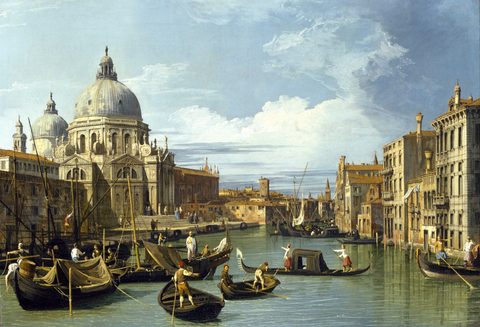
The Entrance to the Grand Canal, Venice
Canaletto, c. 1730
Salute rises where the Grand Canal opens to the basin. Daylight, barges, and a dome that owns the water.
About this work
Canaletto painted The Entrance to the Grand Canal, Venice in about 1730. The canvas is in the Museum of Fine Arts, Houston, and was photographed for the Google Art Project. It looks toward the point where the Grand Canal opens into the basin of San Marco, with the domed church of Santa Maria della Salute rising over the water and barges and gondolas in the daylight. The Salute is a Roman Catholic basilica on the narrow Punta della Dogana between the Grand Canal and the Giudecca Canal, so it is visible to anyone arriving at Piazza San Marco by water. The Grand Canal is the city's main waterway, 3.8 kilometres long, running in a reverse-S curve from the lagoon near the railway station to the basin. Canaletto, born Giovanni Antonio Canal in Venice in 1697, was the leading painter of vedute, detailed city views, of Venice, Rome and London. He worked in England from 1746 to 1756 and died in Venice in 1768.
Sources: Wikimedia Commons · Wikipedia: Canaletto · Wikipedia: Santa Maria della Salute · Wikipedia: Grand Canal (Venice)
FAQ
Where can I buy a framed print of The Entrance to the Grand Canal, Venice?
Here. The Entrance to the Grand Canal, Venice is available as a framed print in three sizes: Small (20 × 14 in) for $195, Medium (24 × 16 in) for $295 and Large (36 × 25 in) for $395. Prices include the frame and US shipping; delivery takes 14–21 days, with 30-day returns.
What size works best for The Entrance to the Grand Canal, Venice?
The file is 8,392 × 5,724 px, so every size is sharp: even Large (36 × 25 in) prints at 229 ppi. Choose Large (36 × 25 in) for a large wall; Small (20 × 14 in) suits a narrower space.
Is it legal to print The Entrance to the Grand Canal, Venice?
Yes. The Entrance to the Grand Canal, Venice is in the public domain: its copyright, if it ever had one, expired long ago. In the United States a faithful photograph of a public-domain painting does not create a new copyright (Bridgeman v. Corel, 1999), so the image can be printed and sold freely.

















