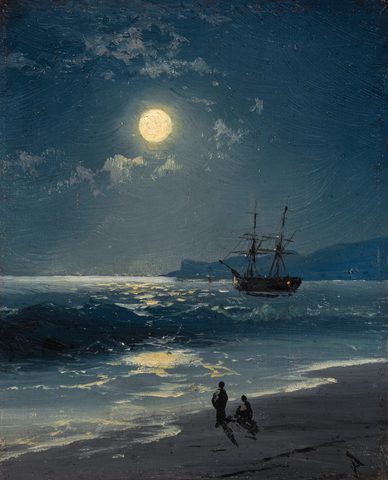
Sailing Ship on a Calm Sea by Moonlight
Ivan Aivazovsky, 1897
A full moon over black water. One ship mid-distance. Two figures on the shore watch the path of light.
About this work
Ivan Aivazovsky painted Sailing Ship on a Calm Sea by Moonlight in 1897, three years before his death. It is a tiny oil on canvas, about 16.5 by 14 centimetres, signed at lower right and dated 1897 on the stretcher, and it is in a private collection. A full moon hangs in a hazy night sky above dark, still water, laying a bright path of light across the sea toward a sailing ship at anchor in the middle distance, while two small figures stand on the shore in the foreground and watch. Aivazovsky, born to Armenian parents in the Black Sea port of Feodosia in Crimea in 1817, was appointed official painter of the Russian Navy and created around 6,000 paintings in a career of almost 60 years, most of them seascapes. Contemporaries wrote that he painted his pictures from memory rather than from nature, and his artistic memory was described as legendary. Critics praised his ability to convey the effect of moving water and of reflected sun and moonlight. A framed print suits a bedroom, a reading nook or a small wall.
Sources: Wikimedia Commons · Wikipedia: Ivan Aivazovsky
FAQ
Where can I buy a framed print of Sailing Ship on a Calm Sea by Moonlight?
Here. Sailing Ship on a Calm Sea by Moonlight is available as a framed print in one size: Small (16 × 20 in) for $195. Prices include the frame and US shipping; delivery takes 14–21 days, with 30-day returns.
What size works best for Sailing Ship on a Calm Sea by Moonlight?
The file is 1,617 × 2,000 px, and it is offered in one size, Small (16 × 20 in), which prints at 100 ppi: fine from a few feet away, softer up close.
Is it legal to print Sailing Ship on a Calm Sea by Moonlight?
Yes. Ivan Aivazovsky died in 1900, so this work has long been in the public domain, and the print is made from a faithful photographic reproduction of it. FrameAnyPhoto has no connection to any museum, collector or holder of the original, and a print does not imply its endorsement.

















