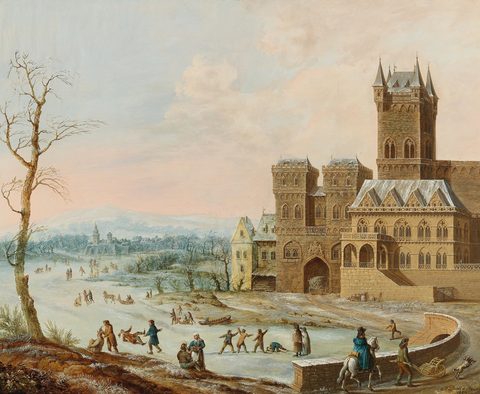
Winter Landscape with a Gothic Castle
Johann Philipp Ulbricht, c. 1820
Gothic castle rising intact above a winter road — full towers and walls in clear cold daylight, not ruin.
About this work
A Gothic castle with tall towers and pointed roofs stands beside a frozen river in this winter landscape by Johann Philipp Ulbricht, dated 1823. On the ice in front of it, people skate, walk and gather in small groups, and a bare tree rises on the left. Snow covers the banks, and the sky is pale and clear in the cold light.
Winter scenes with skaters have a long tradition in northern European painting, going back to the Dutch Golden Age. Ulbricht's picture continues that tradition but places a romantic, castle-like building at the center of the composition.
The cool blues and whites, the bright red and dark clothing of the skaters and the crisp architecture make this a charming painting for the winter season, or any time of year. The image is 4089 × 3352 pixels, good for medium and large prints. It suits a living room, a hallway or a cabin, and is a delightful holiday gift.
Sources: Wikimedia Commons
FAQ
Where can I buy a framed print of Winter Landscape with a Gothic Castle?
Here. Winter Landscape with a Gothic Castle is available as a framed print in three sizes: Small (20 × 16 in) for $195, Medium (24 × 20 in) for $295 and Large (36 × 30 in) for $395. Prices include the frame and US shipping; delivery takes 14–21 days, with 30-day returns.
What size works best for Winter Landscape with a Gothic Castle?
The file is 4,089 × 3,352 px. Medium (24 × 20 in) is the largest size that prints at 150 ppi or more (168 ppi), the sharpest choice for close viewing; Large (36 × 30 in) prints at 112 ppi, fine from a few feet away but softer up close.
Is it legal to print Winter Landscape with a Gothic Castle?
Yes. Winter Landscape with a Gothic Castle is in the public domain: its copyright, if it ever had one, expired long ago. In the United States a faithful photograph of a public-domain painting does not create a new copyright (Bridgeman v. Corel, 1999), so the image can be printed and sold freely.

















