
Vincent van Gogh painted for only about ten years, and for most of that time almost nobody wanted his pictures. Today his sunflowers, starry skies and blossoming branches are among the most loved images in the world, so familiar that it is easy to stop really looking at them. This guide follows his short career place by place, from the Dutch countryside to Paris, Arles, Saint-Rémy and finally Auvers-sur-Oise, through the paintings in the FrameAnyPhoto collection. Along the way we offer some practical thoughts on choosing a Van Gogh to live with, because few artists reward daily looking quite as generously.
A late start in Holland
Van Gogh was born in 1853 in Zundert, in the south of the Netherlands, the son of a Protestant minister. He worked for the art dealers Goupil & Cie, tried teaching and preaching, and only decided to become an artist around 1880, when he was already twenty-seven. From then on his younger brother Theo, himself an art dealer, supported him with money and encouragement, and the hundreds of letters Vincent wrote to Theo are one of the richest records any artist has left of his own working life.
His early Dutch pictures are mostly dark, earthy studies of peasants and weavers, but there are glimpses of the colorist to come. Bulb Fields, painted around 1883, when he was living in The Hague and now in the National Gallery of Art in Washington, shows long stripes of spring flowers running back toward a low horizon. It is one of the rare early works in which bright color takes center stage, and it makes a cheerful, very Dutch picture for a kitchen or entry.
Paris: finding color
In 1886 Van Gogh moved in with Theo in Paris. There he saw the Impressionists and the younger painters around them, studied Japanese woodblock prints, and within two years transformed his palette. Short of money for models, he painted himself again and again. The Self-Portrait of 1887 in the Van Gogh Museum, Amsterdam, belongs to this period: the brushwork has broken into separate, energetic strokes, and the colors are lighter and more daring than anything he had done in Holland. A Van Gogh self-portrait is a striking choice for a study or library, where it can feel like a conversation with the artist himself.
In two years in Paris, Van Gogh went from painting the color of mud to painting the color of light.
Arles: the great year
In February 1888 Van Gogh left for Arles in Provence, hoping to find the clear light and bright color he associated with Japanese prints. The fifteen months that followed produced many of his best-known paintings. That first spring he painted the fruit trees in bloom around the town, including Orchard in Blossom, a fresh, light-filled picture that suits a bedroom or breakfast nook.
In September he turned to the night. Café Terrace at Night, now in the Kröller-Müller Museum in the Netherlands, shows a gas-lit café on a square in Arles under a deep blue, star-filled sky, the night built from blues, violets and greens rather than black. The same month he painted Starry Night Over the Rhône, now in the Musée d’Orsay in Paris, with the town’s lights reflected in long gold streaks on the river and a couple strolling along the bank. Either one is a natural choice for a dining room.
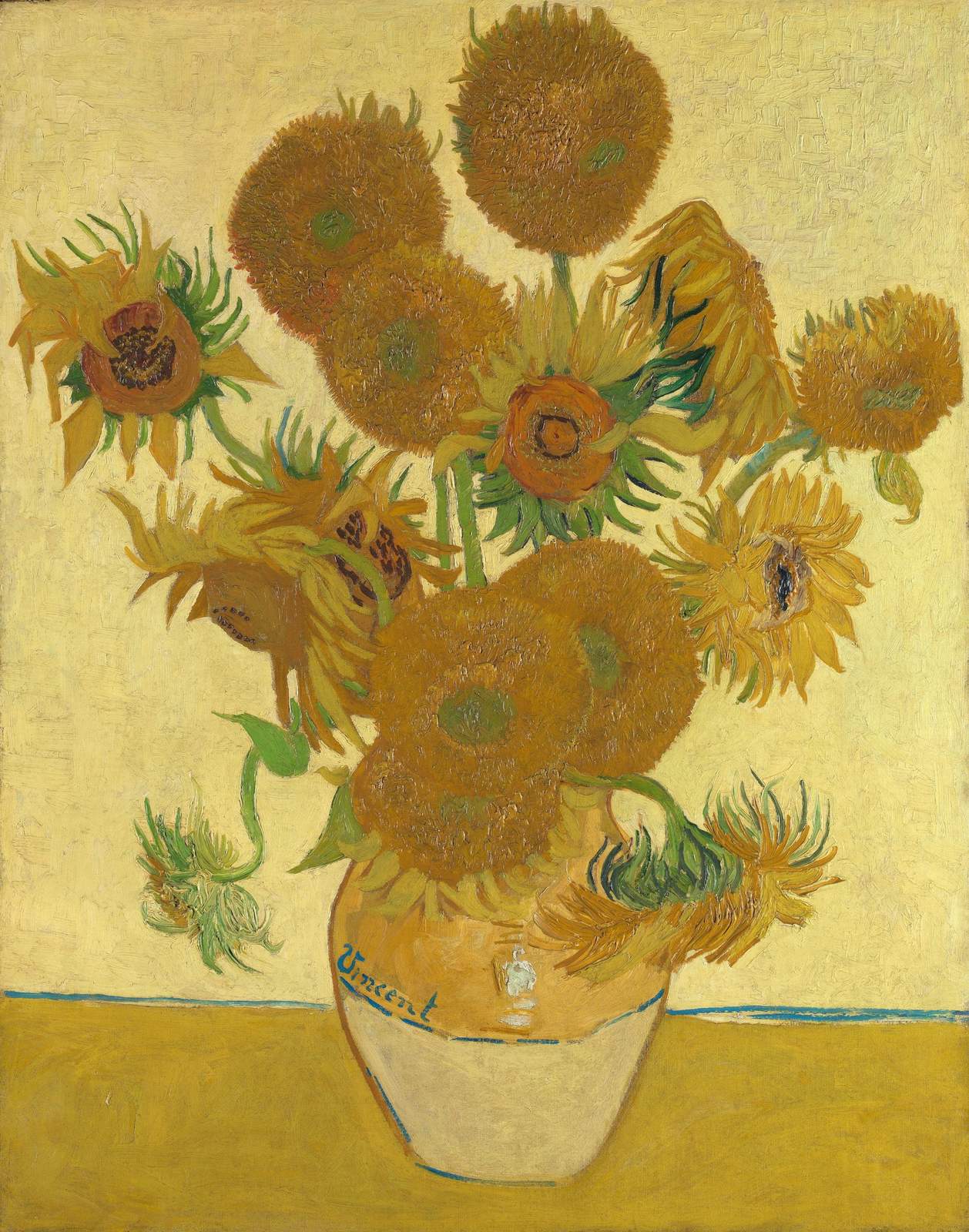
Van Gogh rented the Yellow House on the Place Lamartine and dreamed of a studio shared with other painters. To decorate it for his friend Paul Gauguin, he painted a series of sunflower still lifes in August 1888. The version in the National Gallery, London, Sunflowers, is famous for its daring yellow on yellow. He later painted repetitions of the series, among them Vase with Twelve Sunflowers from early 1889. In October he painted his own room in the Yellow House. The Bedroom, the first of three versions and now in the Van Gogh Museum, uses flat areas of strong color to suggest rest, and it remains the most natural picture imaginable to hang above a bed.
Gauguin arrived in October and stayed about two months. During that time he painted his host at work in Vincent van Gogh Painting Sunflowers, now in the Van Gogh Museum. The visit ended badly. Shortly before Christmas, after a quarrel, Van Gogh suffered a mental crisis and cut off part of his own ear. He recorded his recovery in January 1889 in Self-Portrait with Bandaged Ear and Pipe, an unflinching picture painted in strong reds, oranges and greens.
Saint-Rémy: painting through illness
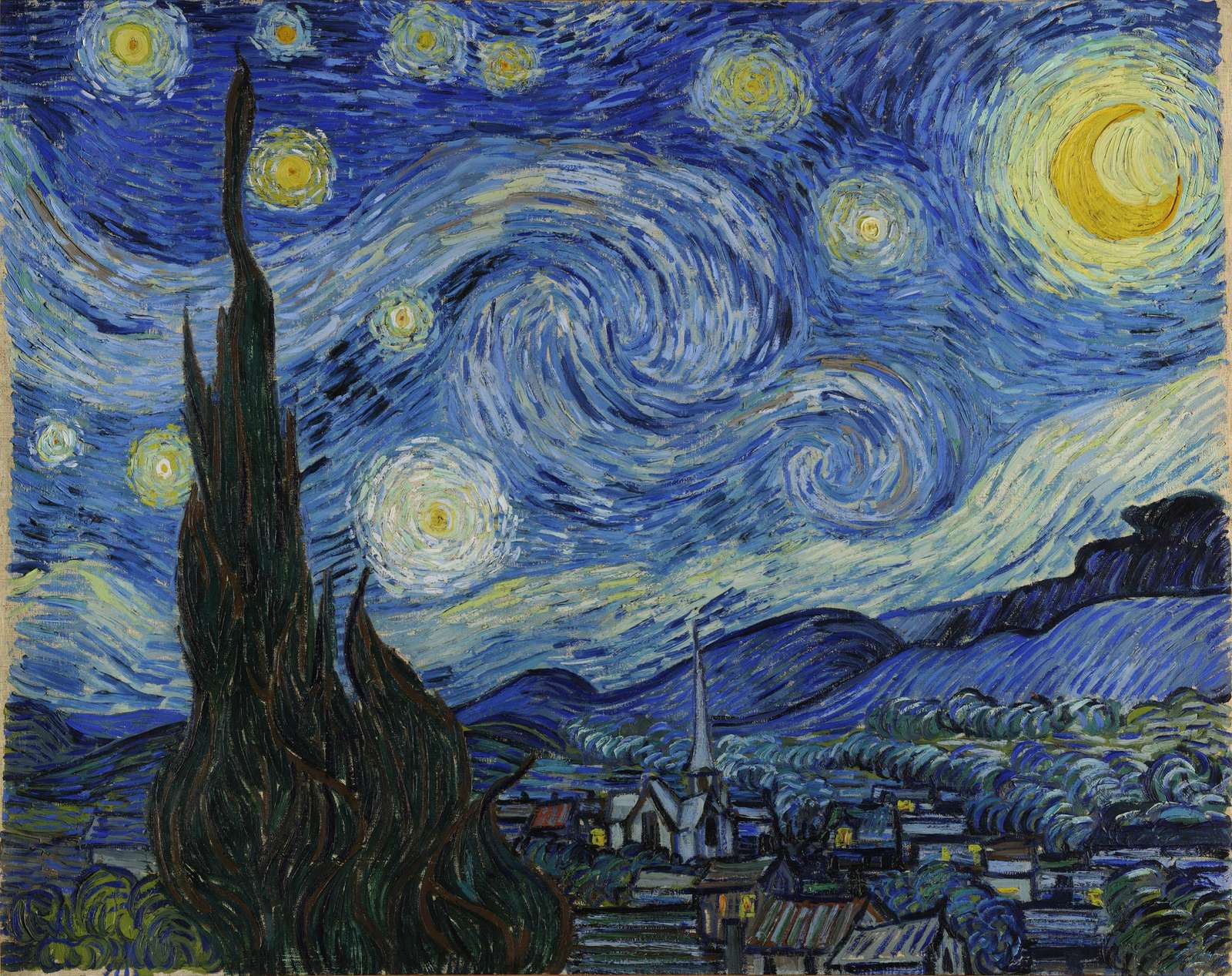
In May 1889 Van Gogh admitted himself to the asylum of Saint-Paul-de-Mausole at Saint-Rémy-de-Provence, where he stayed for a year. Despite repeated attacks of illness, he kept working whenever he could. In June 1889 he painted The Starry Night, now at the Museum of Modern Art in New York, with its swirling sky above a quiet village and a flame-like cypress in the foreground. When he could not go outside, he made his own versions of prints after artists he admired, especially Jean-François Millet. The Siesta (after Millet), now in the Musée d’Orsay, shows two harvesters asleep in the shade of a haystack, a scene of rest translated into Van Gogh’s own vivid colors.
Two of the most joyful pictures in the collection come from the end of this year. At the end of January 1890 Theo and his wife Jo had a son, named Vincent after his uncle, and Van Gogh painted Almond Blossom for the baby: white blossoms on twisting branches against a clear blue sky. It remains one of the best-loved gifts for a new baby or a nursery. That May, just before leaving Saint-Rémy, he painted a still life of Irises in a vase, the version now in the Metropolitan Museum of Art.
Almond Blossom was painted as a gift for a newborn, and it still makes one of the loveliest nursery pictures we know.
Auvers-sur-Oise: the last summer
In May 1890 Van Gogh moved to Auvers-sur-Oise, north of Paris, near the doctor Paul Gachet. In about ten weeks he painted dozens of pictures of the village and its fields, among them Poppy Field and Wheatfield with Crows, painted in July 1890 and now in the Van Gogh Museum. Wheatfield with Crows is often described as his last painting, but that is a legend; he painted other works after it. Van Gogh died in Auvers on 29 July 1890, aged thirty-seven. Theo died only six months later, and it was largely Jo van Gogh-Bonger who devoted the following years to publishing the letters and making her brother-in-law’s work known.
Choosing a Van Gogh for your home
Van Gogh’s colors are strong, so let the painting set the tone of the room. Blue night scenes such as The Starry Night and Starry Night Over the Rhône look rich in a bedroom or living room and pair beautifully with navy, gray or warm wood. The sunflowers and Bulb Fields bring warmth to a kitchen or dining room. Almond Blossom and Orchard in Blossom are soft enough for a nursery or bedroom. Wheatfield with Crows is a wide, low picture, so it works best above a sofa, sideboard or bed where a long shape fills the space.
Every FrameAnyPhoto print is framed and ready to hang in three sizes, at $195, $295 and $395, and each painting is printed at its true proportions so nothing is cropped. The gilded Wood Ornament frame gives Van Gogh a classic gallery feel, while the Black Metallic frame makes his colors look even brighter and more modern. You can browse every work in our Van Gogh paintings collection or on the Vincent van Gogh artist page, and our guide to choosing the right size and frame has more practical advice.