
Every family has one: the person who reads the footnotes, watches the launch at two in the morning and can explain, with real enthusiasm, why the sky is blue. They are wonderful company and surprisingly hard to shop for. Gadgets go out of date, and most science-themed decor leans toward the cartoonish. A framed photograph or portrait of a great scientist is something else. It honors the people they admire, it is a real historical document, and it looks good on a wall long after the holidays.
Below are the science pictures in our collection that we would give to a physicist, an engineer, a teacher, a medical student or simply a curious mind, with a little history behind each one. Every work is a real photograph or painting from a museum or archive, printed at its true shape and sent framed and ready to hang. You can see them all in our famous scientists portraits collection.
A framed portrait of a great scientist honors the people they admire, and it is a real historical document, not a novelty.
For the physicist: Albert Einstein, 1921
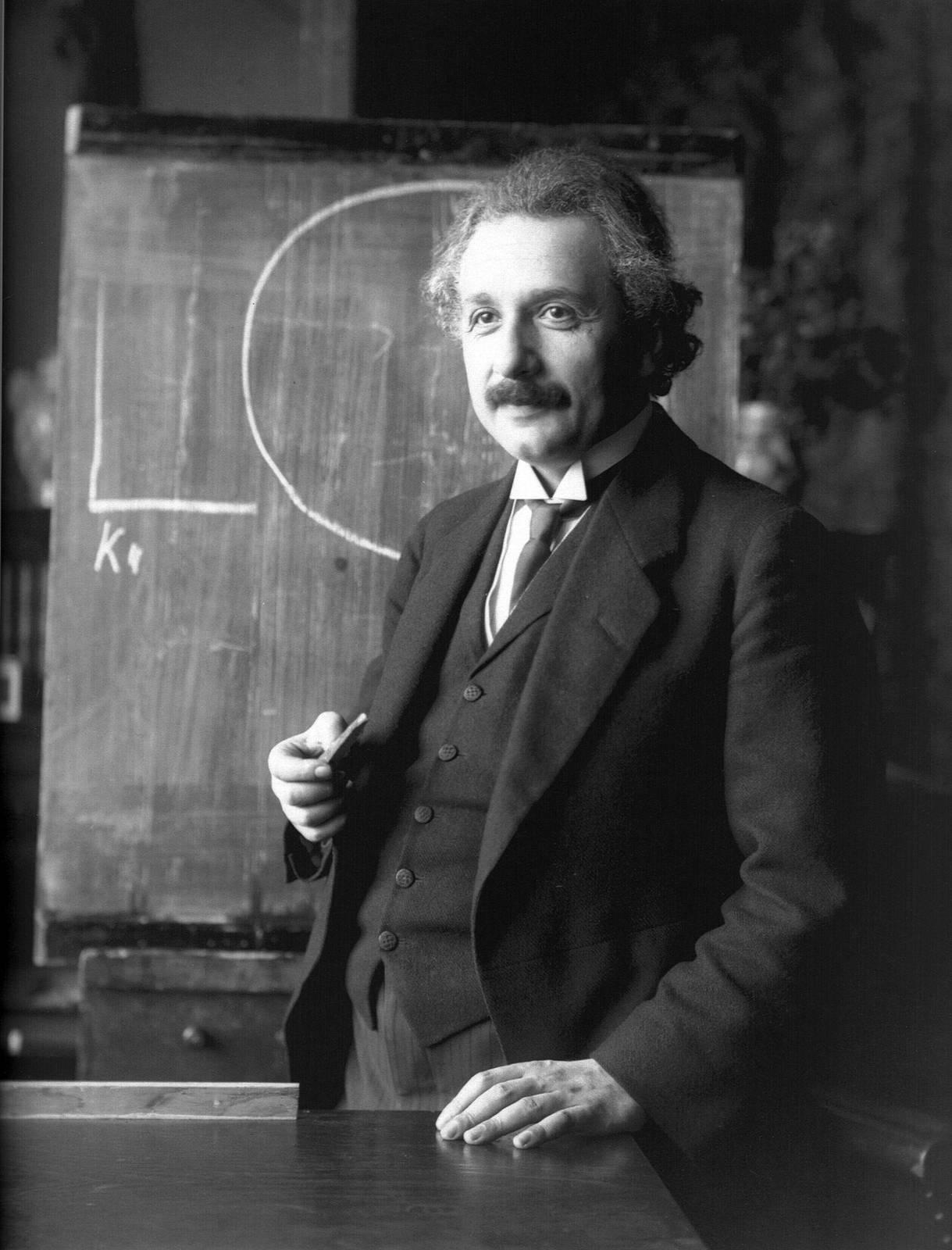
We carry two photographs of Albert Einstein, both from 1921, the year for which he was awarded the Nobel Prize in Physics “for his services to Theoretical Physics, and especially for his discovery of the law of the photoelectric effect.” (The prize was held over and announced in 1922.)
The more lively of the two is by the Austrian photographer and engraver Ferdinand Schmutzer, who photographed Albert Einstein during a lecture in Vienna. Einstein stands at a blackboard with a piece of chalk in his hand, his hair already famously untamed, looking less like a monument than a teacher in the middle of a thought. It is our favorite gift for anyone who teaches.
The second, by the Washington studio Harris & Ewing, is a formal portrait made the same year, when Einstein first traveled to the United States. It is quieter and more dignified, a good choice for a study or an office.
For the chemist or the trailblazer: Marie Curie
Marie Curie remains the only person to win Nobel Prizes in two different sciences: physics in 1903, shared with Pierre Curie and Henri Becquerel for their work on radioactivity, and chemistry in 1911 for the discovery of the elements polonium and radium. She was also the first woman to win a Nobel Prize at all.
Our photograph of Marie Curie shows her in her laboratory in Paris in 1912, a year after the second prize. She stands, dressed in black, among the benches, glassware and instruments of her working life. It is not a glamorous image, and that is its power: it shows the work. For a young woman heading into science or medicine, we can hardly think of a better picture to hang above a desk.
For the engineer and the tinkerer: Tesla and Edison
Nikola Tesla spent much of 1899 at an experimental station in Colorado Springs, studying high-voltage electricity and wireless transmission of power. The photograph of Nikola Tesla with His Equipment is one of the most famous images of the era: Tesla sits calmly reading while enormous electrical discharges arc across the room above him. It was in fact made as a multiple exposure, a showman’s trick, which makes it even more fun to own. It is a striking, graphic print that suits a garage workshop as well as a living room.
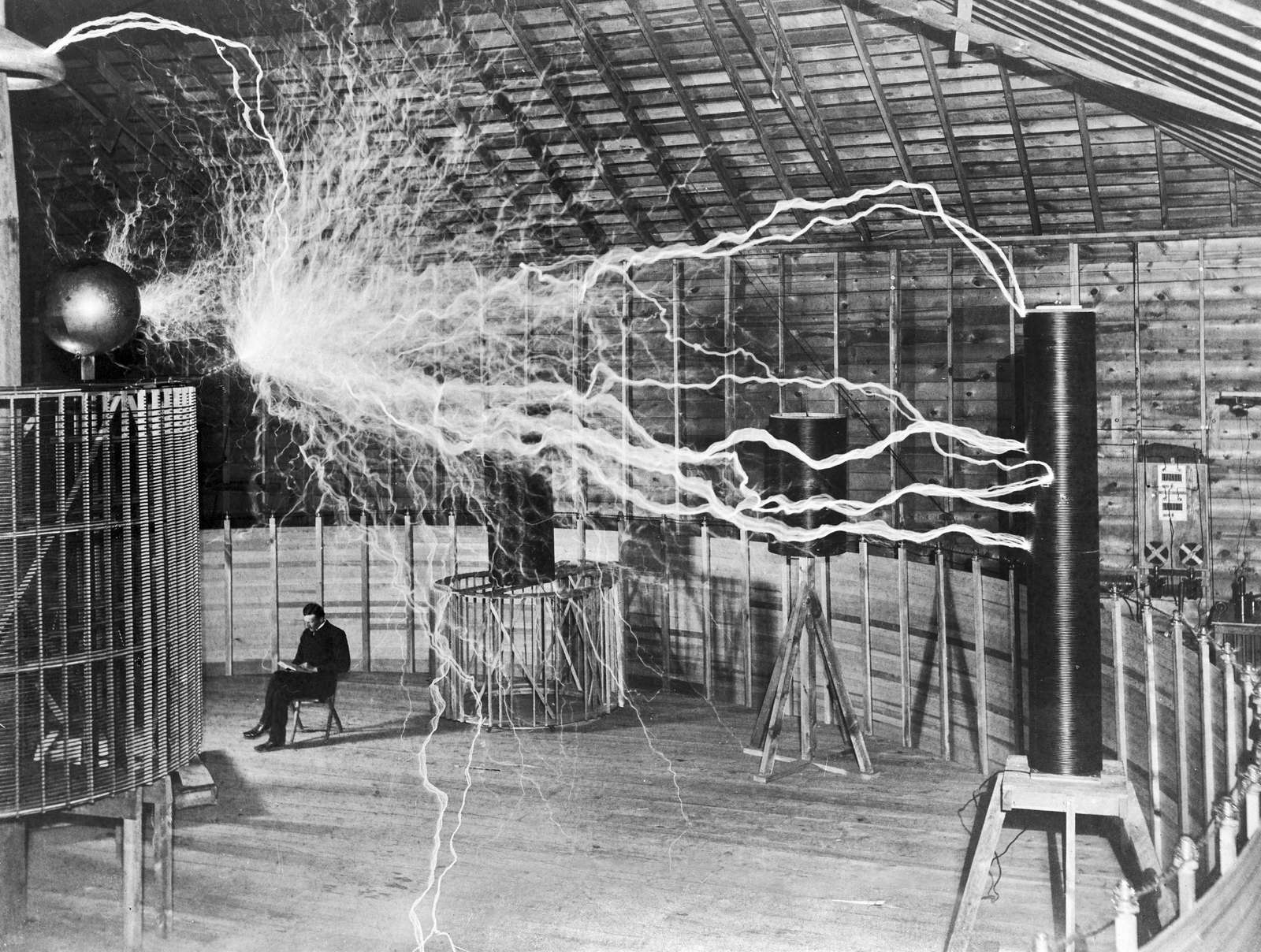
Hang it beside our 1904 portrait of Thomas Edison, photographed at about 57, hands in his pockets and looking straight at the camera, and you have the two great rivals of the electrical age together. Edison’s Menlo Park laboratory gave the world the phonograph and a practical incandescent light bulb; Tesla championed the alternating current system that came to power most of the world. A pair like this makes a fine conversation piece for an electrician or an electrical engineer.
Hang Tesla beside Edison and you have the two great rivals of the electrical age on one wall.
For the astronomer: Galileo
The Flemish painter Justus Sustermans was court painter to the Medici in Florence, and in the mid-1630s he painted Galileo Galilei, then in his seventies. By that time Galileo had turned his telescope on the sky, seen the moons of Jupiter and the phases of Venus, and been tried by the Roman Inquisition in 1633; he spent his final years under house arrest near Florence. Sustermans shows him with a white beard and a direct, searching gaze. It is a true Old Master portrait, and it belongs on the wall of anyone who owns a telescope. Add a picture from our astronomy prints and the gift tells a four-hundred-year story.
For the history-of-science buff: Franklin and Los Alamos
Before he was a diplomat and founding father, Benjamin Franklin was famous across Europe as a scientist. His experiments with electricity and his invention of the lightning rod won him the Royal Society’s Copley Medal in 1753. The Scottish painter David Martin painted Benjamin Franklin in London in 1767, reading at his desk in a blue coat, with a bust of Isaac Newton looking on from the left. A version of the portrait hangs in the White House. It is a warm, richly colored painting that works especially well in a library or home office.
For a more modern chapter, we carry photographs from the Manhattan Project at Los Alamos, including the identification badge photographs of J. Robert Oppenheimer, the laboratory’s scientific director, and of a young Richard Feynman, who would later share the 1965 Nobel Prize in Physics for his work on quantum electrodynamics. There is also the Los Alamos Main Gate from 1943. These are plain, documentary images, and they carry real weight: the badge photographs show brilliant people at the start of one of the most consequential projects of the twentieth century. They suit someone who has read the history and wants something serious rather than decorative.
Practical notes for giving
- Sizes and prices. Most works come framed in three sizes: Small at $195, Medium at $295 and Large at $395, with free shipping in the US. Each work is printed at its original shape, so exact inches vary; every work page lists them.
- Which size. Portraits read well at Small or Medium above a desk or bookshelf. The Tesla photograph has a lot of detail in the sparks and is worth going Large.
- Which frame. The slim Black Metallic frame suits the black-and-white photographs. The gold Wood Ornament frame suits the painted portraits of Galileo and Franklin.
- Make a set. Two or three portraits hung in a row, such as Galileo, Franklin and Einstein, make a small hall of fame for a study or classroom.
- Timing. Every frame is made to order, and delivery takes about 14 to 21 days, so order in the first days of December if you want it under the tree. Details are on our shipping and returns page.
For more ideas, see our guide to Hubble and James Webb telescope prints, the story behind Earthrise and the Apollo photographs, our gift guide for history lovers, or browse the full famous scientists collection.