
The Apollo photographs are easy to treat as illustrations to a story we already know: a rocket leaves Florida, a module settles on the Moon, a flag is planted, the travelers come home. The pictures themselves are stranger and more specific than that outline. They are also, for most of us, the only way we have ever seen those places. The prints in this collection are made from NASA’s own mission records, not from later restatements of the same events.
Four photographs are enough to show how wide the record is. One looks back at Earth from lunar orbit. One shows the machine leaving the ground. Two were made in the Sea of Tranquility, a few feet apart and hours after the first landing. Together they are less a timeline than a set of distances: home, the pad, a person, a mark in the dust.
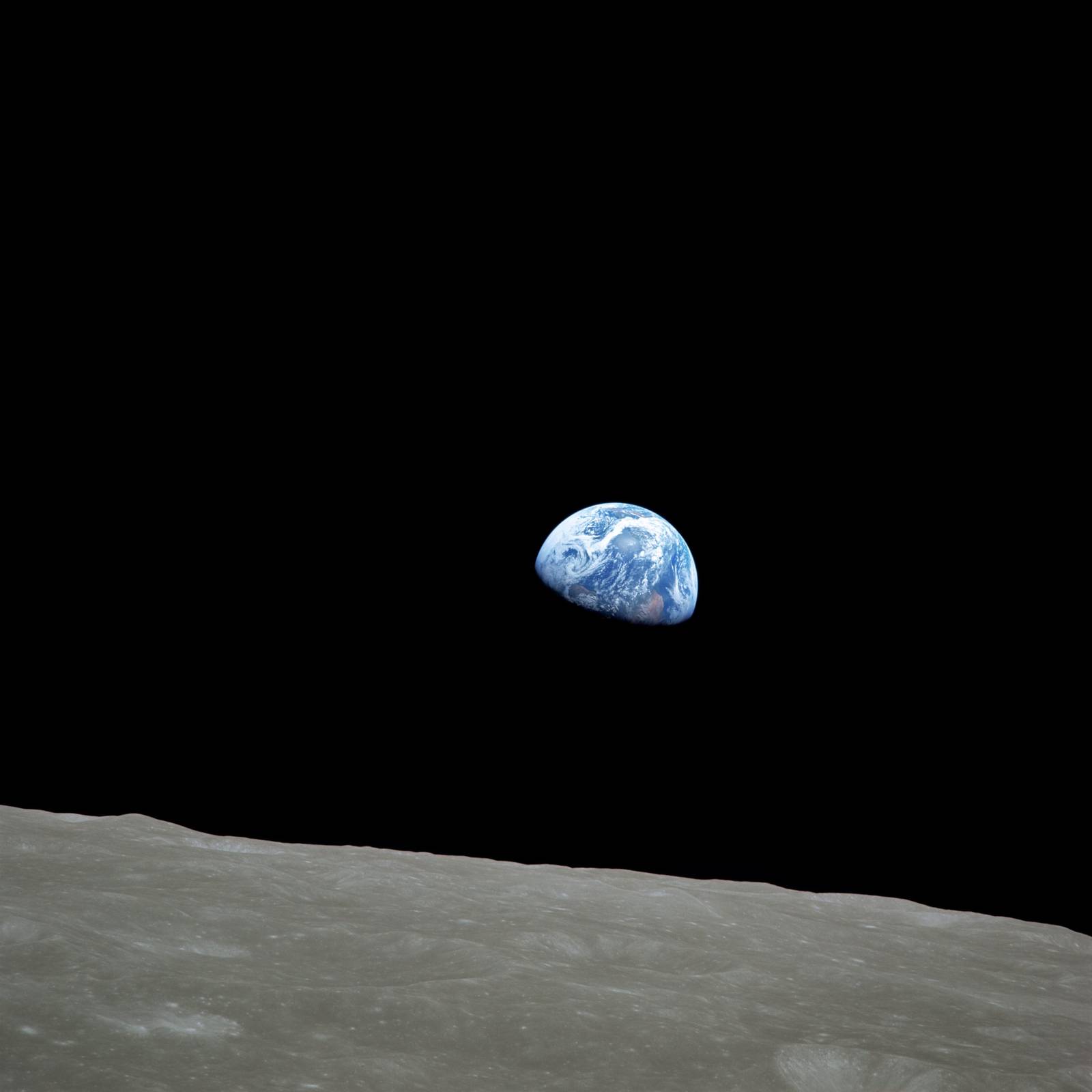
The Earth comes into the picture
On Christmas Eve 1968, during Apollo 8, Bill Anders photographed the Earth rising over the Moon’s horizon. NASA identifies the frame as AS08-14-2383. Anders was lunar module pilot; his crewmates were Frank Borman and Jim Lovell. They were the first people to leave Earth orbit and circumnavigate the Moon. The agency’s caption is exacting in the way flight records are: the Earth stands about five degrees above the lunar horizon, the sunset terminator crosses Africa, and North and South America lie under cloud. The picture was made around 10:40 a.m. Houston time.
What the caption cannot quite say is why the image still stops a room. The Moon, which the crew had traveled to see, occupies most of the frame as a dead, close foreground. The living planet is the smaller object, and the more fragile one. They had gone to inspect another world and came back with a photograph of home. That reversal is the picture’s lasting charge. Other views of the planet from deep space, including later Apollo frames, are gathered in Earth from space.
They had gone to inspect another world and came back with a photograph of home.
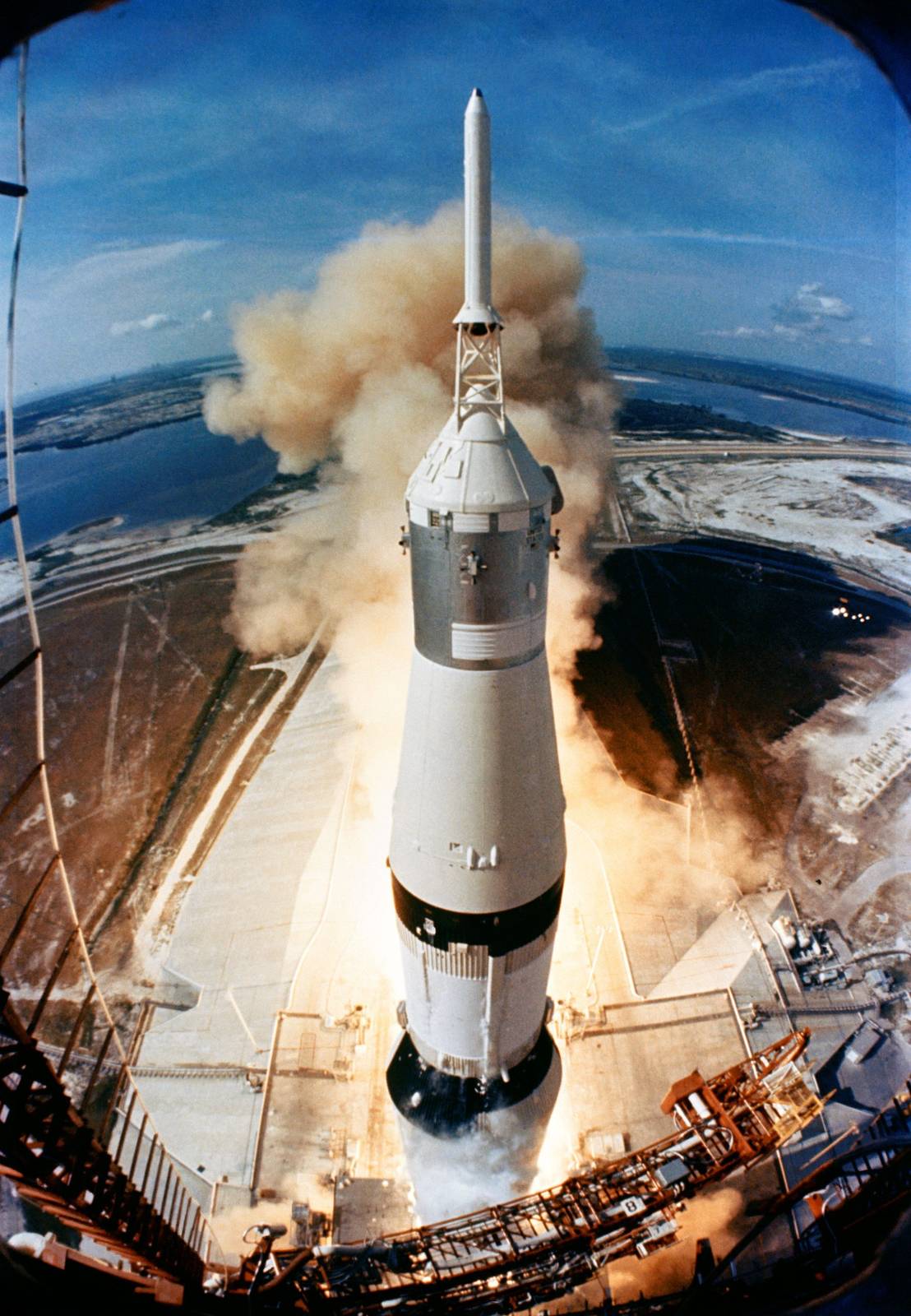
The machine that left the ground
If Earthrise is a picture of arrival in a new kind of space, NASA photograph S69-39961 is a picture of departure from an ordinary one. It shows Apollo 11 leaving Kennedy Space Center on 16 July 1969, the Saturn V already clear of the tower, a white column of fire and exhaust holding the vehicle in the sky. Neil Armstrong, Buzz Aldrin and Michael Collins were in the spacecraft at the tip. Four days later Armstrong and Aldrin would descend in the lunar module Eagle to the Sea of Tranquility, while Collins remained in lunar orbit aboard Columbia.
Launch photographs earn their place on a wall by being both documentary and sculptural. The tower, the vehicle and the plume have a clear vertical order. You do not need the mission patch to feel the scale, or to understand that this is the beginning of a journey whose ending is not visible in the frame. Apollo 8’s own liftoff, on 21 December 1968, makes the same kind of claim from the earlier flight that produced Earthrise.
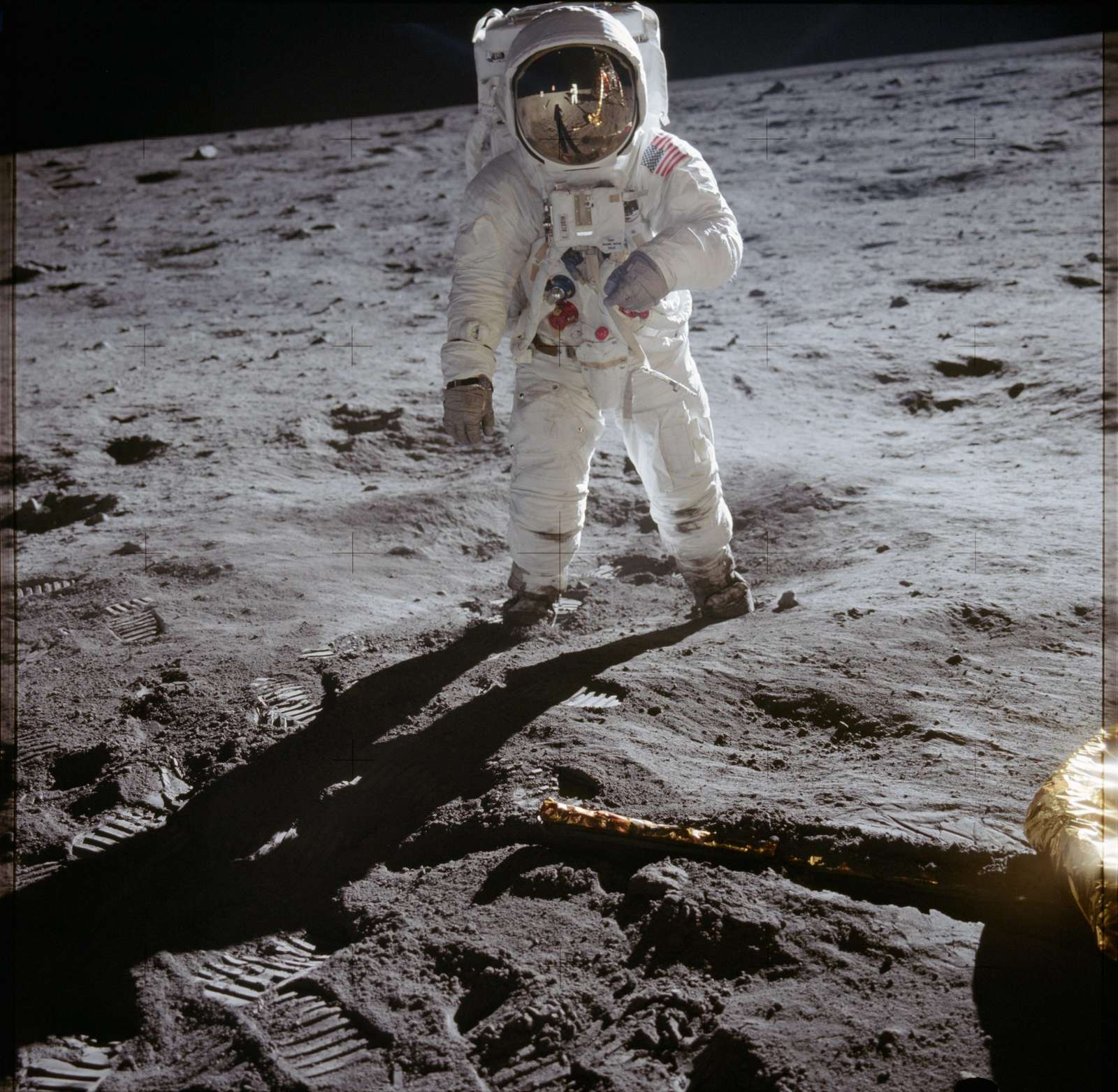
A person in the landscape
The most familiar photograph from the lunar surface is not a wide view of the lander. It is a portrait. On 20 July 1969, Armstrong photographed Buzz Aldrin walking near Eagle. NASA’s frame number is AS11-40-5903. The Johnson Space Center caption notes that the visor reflects the scene in front of Aldrin: the lunar module, and Armstrong himself taking the picture. Footprints are visible in the foreground. The gold visor, made to manage the sunlight, happens also to hold the only likeness of Armstrong on the surface, because he was the one behind the camera.
That coincidence is part of why the picture rewards living with, not only recognizing. It is a person standing in an actual place, suited and slightly grounded by dust, with another person and a spacecraft caught in a curved mirror. The Moon here is not an emblem. It is underfoot. A related frame, Aldrin beside Eagle, taken the same day, shows the lander more fully and the figure nearer its ladder.
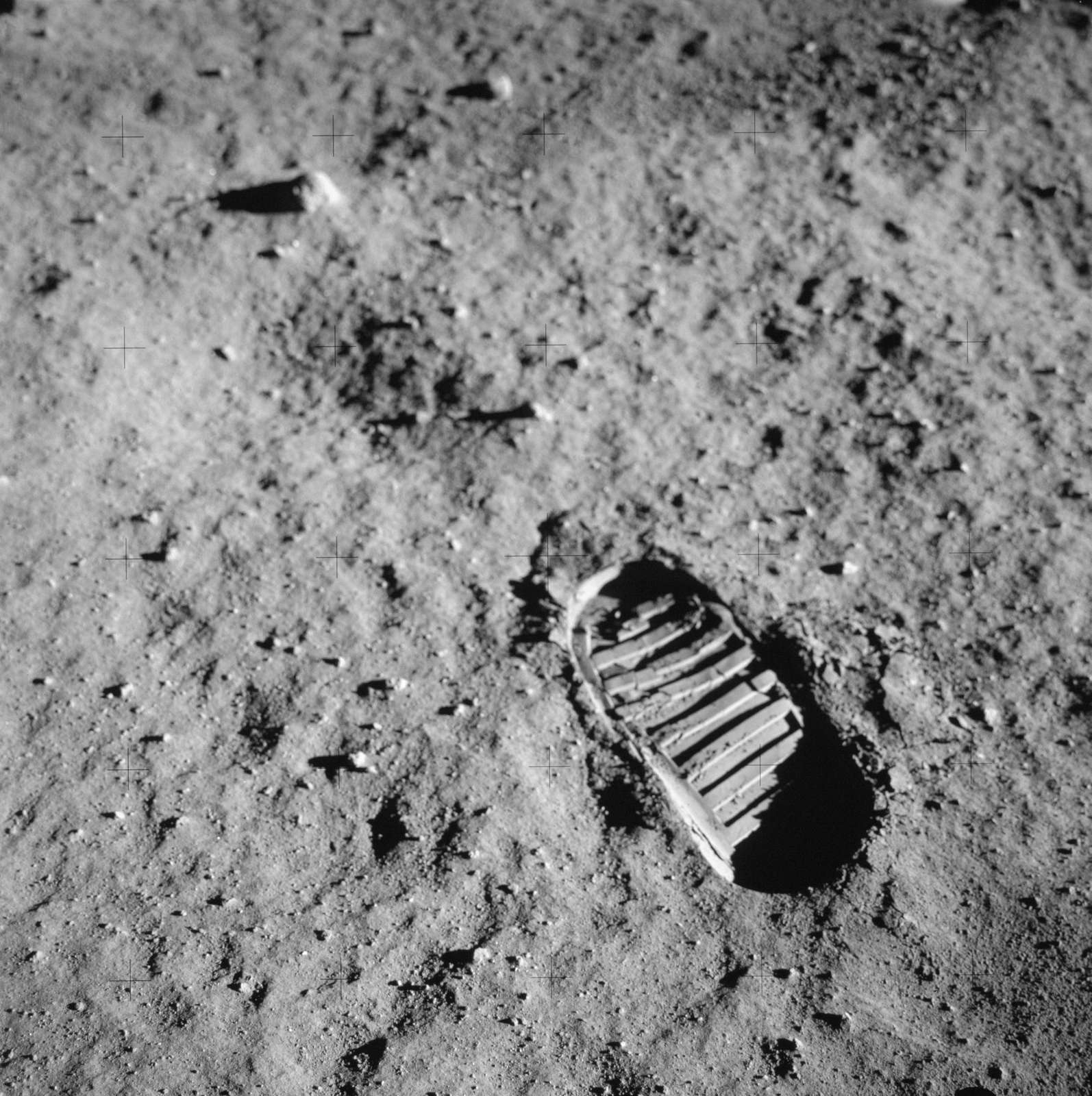
A mark that needed no monument
Aldrin also made a photograph that is almost only a detail: a bootprint in the lunar soil, NASA frame AS11-40-5878. The tread is clear, the dust fine, the shadow sharp inside the mark. There is no horizon and no flag. The print is already a step behind the person who made it. As a public image it has been asked to stand for the whole landing. As a picture on a wall it is quieter than that. It shows how the ground recorded a visit, and how little of the visit the ground required.
This is the closest of the four views, and in some ways the most intimate. After the Earth from a hundred thousand miles and the rocket from the dunes of the Cape, we are looking at a single impression, made because someone thought the soil itself was worth documenting. The humility of the subject is misleading. Without the long journey, there is no mark to photograph. The print is modest only in its crop.
Pictures to live with
These frames were government records before they were famous. That origin is a reason to trust them, and a reason they remain good company in a room. They do not need a caption to explain a triumph, though the facts are worth knowing. They need a wall long enough for the circle of the Earth, or tall enough for a Saturn V, or quiet enough for a bootprint.
The larger set is in the Apollo moon landing photographs and in the space collection, from pad and crawler to later views of Earth. Each print is made from NASA’s file and arrives framed, ready to hang. The history is public. The choice is which distance you want in front of you every day.