Benjamin Franklin
David Martin, 1767
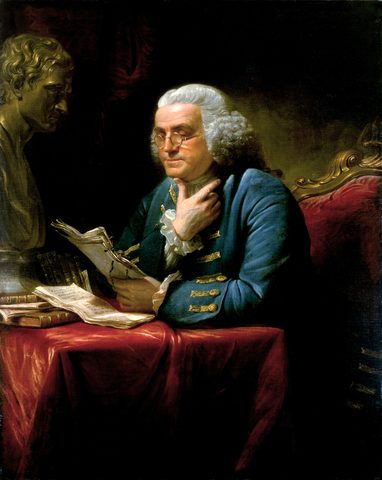
Martin's Franklin — thinking pose, spectacles, and Newton's bust at his side.
About this work
Benjamin Franklin sits in thought, his thumb under his chin, reading a document through his spectacles, with a bust of Isaac Newton gazing down at him, in this 1767 portrait by the Scottish painter David Martin. This version hangs in the White House. Franklin was in London at the time as an agent for the colony of Pennsylvania, already famous across Europe for his experiments with electricity, which had earned him the Royal Society's Copley Medal and election as a Fellow; the bust of Newton places him in the line of great natural philosophers. The portrait was commissioned by the Edinburgh merchant Robert Alexander, a friend of Franklin's, and Franklin liked it enough to order a copy for himself. Franklin, born in Boston in 1706, became a printer and newspaper publisher in Philadelphia, a scientist and inventor of the lightning rod and bifocals, and a statesman. He helped draft and signed the Declaration of Independence, served as American minister to France, where he negotiated the alliance of 1778, and was a delegate to the Constitutional Convention. He died in Philadelphia in 1790. Martin, born in 1737, trained under Allan Ramsay and became a leading portrait painter in Edinburgh. He died in 1797.
Sources: Wikimedia Commons · Wikipedia: Benjamin Franklin · Wikipedia: David Martin (artist)
FAQ
Where can I buy a framed print of Benjamin Franklin?
Here. Benjamin Franklin is available as a framed print in two sizes: Small (16 × 20 in) for $195 and Medium (19 × 24 in) for $295. Prices include the frame and US shipping; delivery takes 14–21 days, with 30-day returns.
What size works best for Benjamin Franklin?
The file is 2,386 × 3,000 px, so Small (16 × 20 in) is the sharpest choice at 149 ppi. Medium (19 × 24 in) prints at 125 ppi: fine from a few feet away, softer up close.
Is it legal to print Benjamin Franklin?
Yes. This painting is in the public domain: David Martin died in 1797, so its copyright, if it ever had one, expired long ago. In the United States a faithful photograph of a public-domain painting does not create a new copyright (Bridgeman v. Corel, 1999), so the image can be printed and sold freely.

















