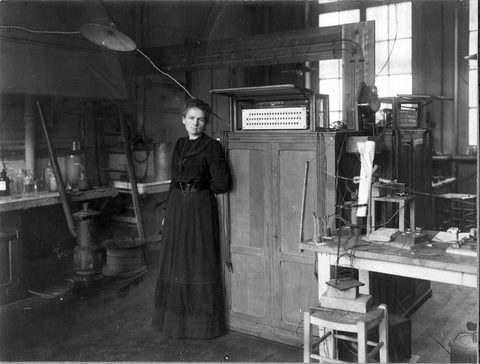
Marie Curie
Unknown photographer, 1912
Marie Curie in her Paris laboratory in 1912. Photographer unrecorded.
About this work
This photograph shows Marie Curie in her laboratory in Paris in 1912. The photographer was not recorded. Curie, born Maria Skłodowska in Warsaw in 1867, was a Polish and naturalised French physicist and chemist who carried out pioneering research on radioactivity, a term she coined. She shared the 1903 Nobel Prize in Physics with her husband, Pierre Curie, for their research on the radiation phenomena discovered by Henri Becquerel. In 1911, the year before this photograph, she won the Nobel Prize in Chemistry for discovering radium and polonium and for isolating radium. She was the first woman to win a Nobel Prize, the first person to win twice, and is still the only person to win Nobel Prizes in two different sciences. She named polonium after her native country. Pierre died in a Paris street accident in 1906, and that same year she became the first woman to be a professor at the University of Paris. She died in 1934, aged 66, of aplastic anaemia, probably caused by radiation exposure during her research.
Sources: Wikimedia Commons · Wikipedia: Marie Curie
FAQ
Where can I buy a framed print of Marie Curie?
Here. Marie Curie is available as a framed print in two sizes: Small (20 × 15 in) for $195 and Medium (24 × 18 in) for $295. Prices include the frame and US shipping; delivery takes 14–21 days, with 30-day returns.
What size works best for Marie Curie?
The file is 3,556 × 2,695 px. Small (20 × 15 in) is the largest size that prints at 150 ppi or more (178 ppi), the sharpest choice for close viewing; Medium (24 × 18 in) prints at 148 ppi, fine from a few feet away but softer up close.
Is it legal to print Marie Curie?
Very likely, and here is the basis. The photograph of Marie Curie in her laboratory dates from 1912 and its photographer is not recorded. Wikimedia Commons lists it as public domain because of its age, and a photograph published in or near 1912 is in the public domain in the United States, where works published before 1931 are out of copyright. We cannot confirm when it was first published, so we state the basis rather than promise it, and we print it on that basis.

















