Albert Einstein
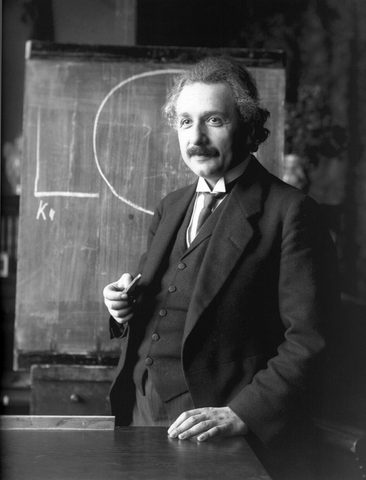
Ferdinand Schmutzer, 1921
About this work
The Austrian photographer and engraver Ferdinand Schmutzer (1870–1928) photographed Albert Einstein during a lecture in Vienna in 1921. Einstein was then 42 and working in Berlin, where he had moved in 1914 to join the Prussian Academy of Sciences. In 1905, sometimes called his miracle year, he had published four groundbreaking papers: on the photoelectric effect, on Brownian motion, on special relativity, and on the equivalence of mass and energy, the source of E = mc², which has been called "the world's most famous equation". In 1915 he completed the general theory of relativity, which brought gravitation into his system of mechanics. In 1922 he was awarded the 1921 Nobel Prize in Physics for his services to theoretical physics and especially for his discovery of the law of the photoelectric effect. Schmutzer's work is held by many museums, among them the British Museum, the Brooklyn Museum and the Minneapolis Institute of Art.
Sources: Wikimedia Commons · Wikipedia: Albert Einstein · Wikipedia: Ferdinand Schmutzer
Print facts
- Native resolution
- 2,523 × 3,313 px
- Sharp at 150 ppi up to
- 16 × 22 in
- Sizes
- Small (15 × 20 in) · $100 · 166 ppi
Medium (18 × 24 in) · $150 · 138 ppi - Price includes
- Frame and US shipping · 14–21 days · 30-day returns
FAQ
Where can I buy a framed print of Albert Einstein?
Here. Albert Einstein is available as a framed print in two sizes: Small (15 × 20 in) for $100 and Medium (18 × 24 in) for $150. Prices include the frame and US shipping; delivery takes 14–21 days, with 30-day returns.
What size works best for Albert Einstein?
The file is 2,523 × 3,313 px. Small (15 × 20 in) is the largest size that prints at 150 ppi or more (166 ppi), the sharpest choice for close viewing; Medium (18 × 24 in) prints at 138 ppi, fine from a few feet away but softer up close.
Is it legal to print Albert Einstein?
Yes. Ferdinand Schmutzer made the photograph in 1921 and died in 1928, so its copyright has expired in Austria and it is in the public domain in the United States as a work published before 1931. A faithful reproduction of a public-domain photograph does not create a new copyright in the United States.