
Few photographs have changed the look of the modern home quite like the pictures made by space telescopes. A generation ago, a print of a nebula meant an artist’s impression. Today it can mean an actual observation, made from above the atmosphere and released to the public by NASA and its partners, with colors and contrast worked out by scientists and image specialists who know exactly what each filter recorded. Those pictures are why our Hubble and James Webb telescope prints are among the most requested in the shop.
This guide walks through six of them, from Hubble’s early years to Webb’s first seasons, with a little history for each and some practical advice on choosing a size and frame. It is written for anyone shopping for a space print, whether for a child’s room, a study, or a gift for the person who still looks up on clear nights.
Two telescopes, two kinds of light
The Hubble Space Telescope was launched aboard the space shuttle Discovery in April 1990. Its 2.4-meter mirror sees mostly visible and ultraviolet light, with some near-infrared, which is why so many Hubble pictures feel familiar: they show roughly the kind of light our eyes are built for, only from much farther away. The James Webb Space Telescope, launched on an Ariane 5 rocket on Christmas Day 2021, is a different instrument. Its 6.5-meter mirror is made of eighteen gold-coated hexagonal segments, and it works in the infrared, far from Earth, kept cold behind a sunshield the size of a tennis court.
That difference matters when you choose a print. Infrared light passes through dust that blocks visible light, so Webb can see stars still wrapped in the clouds that made them, and galaxies so distant that their light has been stretched out of the visible range. Because no eye can see infrared, every Webb color is a translation: shorter wavelengths are usually shown as blue, longer ones as red. Hubble images are assembled the same way from separate filters. A space telescope picture is a measurement first and a picture second, and the best of them manage to be both without apology.
A space telescope picture is a measurement first and a picture second, and the best of them manage to be both without apology.
The telescope that had to be fixed
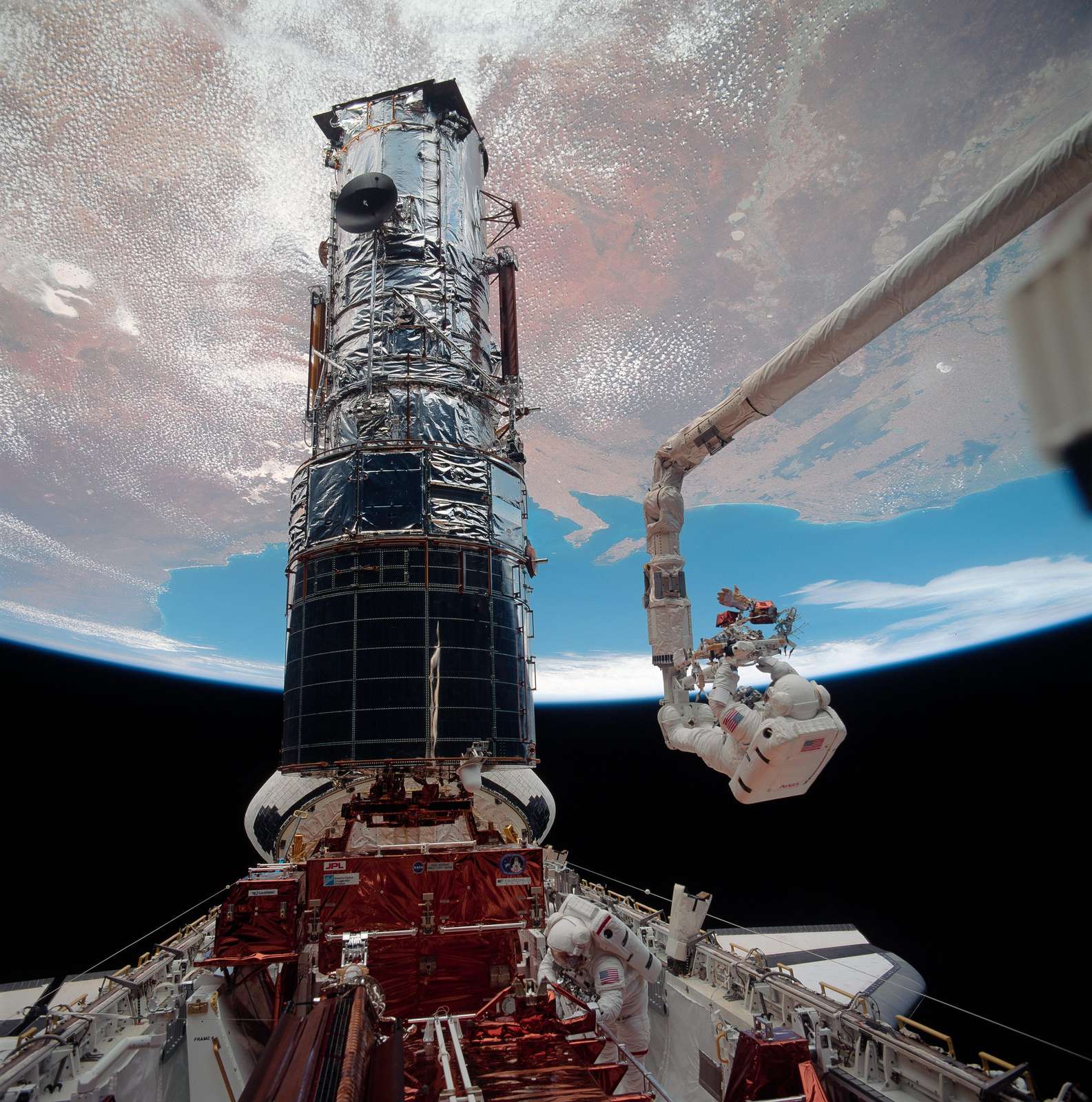
Hubble’s early story is one of disappointment turned around. Soon after launch, engineers found that its primary mirror had been ground to a slightly wrong shape, leaving its images blurred. In December 1993 the crew of the shuttle Endeavour flew the first servicing mission, installing corrective optics and a new camera over a series of spacewalks. This photograph shows Story Musgrave, standing on the end of the shuttle’s robot arm, rising toward the top of the telescope, with Jeffrey Hoffman below.
It is a quietly heroic picture: the views of distant galaxies depend on people working in pressurized suits with hand tools. It pairs especially well with any of the Hubble images below, and it is a natural gift for engineers.
The Pillars of Creation, seen twice
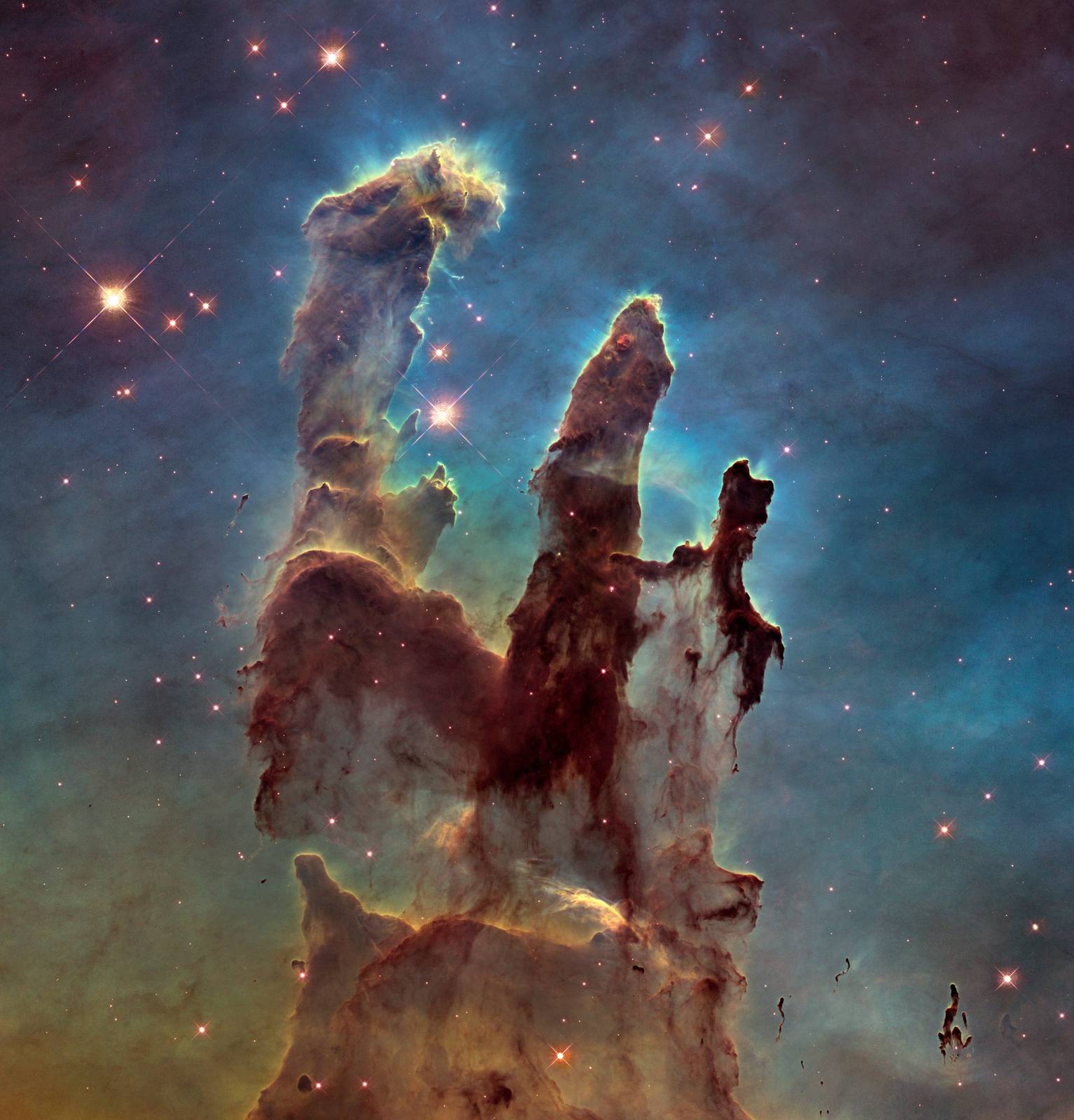
The repaired Hubble made its most famous picture in 1995: three towering columns of cold gas and dust in the Eagle Nebula, about 6,500 light-years away, their tips lit and slowly worn away by the radiation of hot young stars nearby. Inside the columns, new stars are forming. Astronomers nicknamed the image the Pillars of Creation, and Hubble returned to the same region in later years with newer cameras.
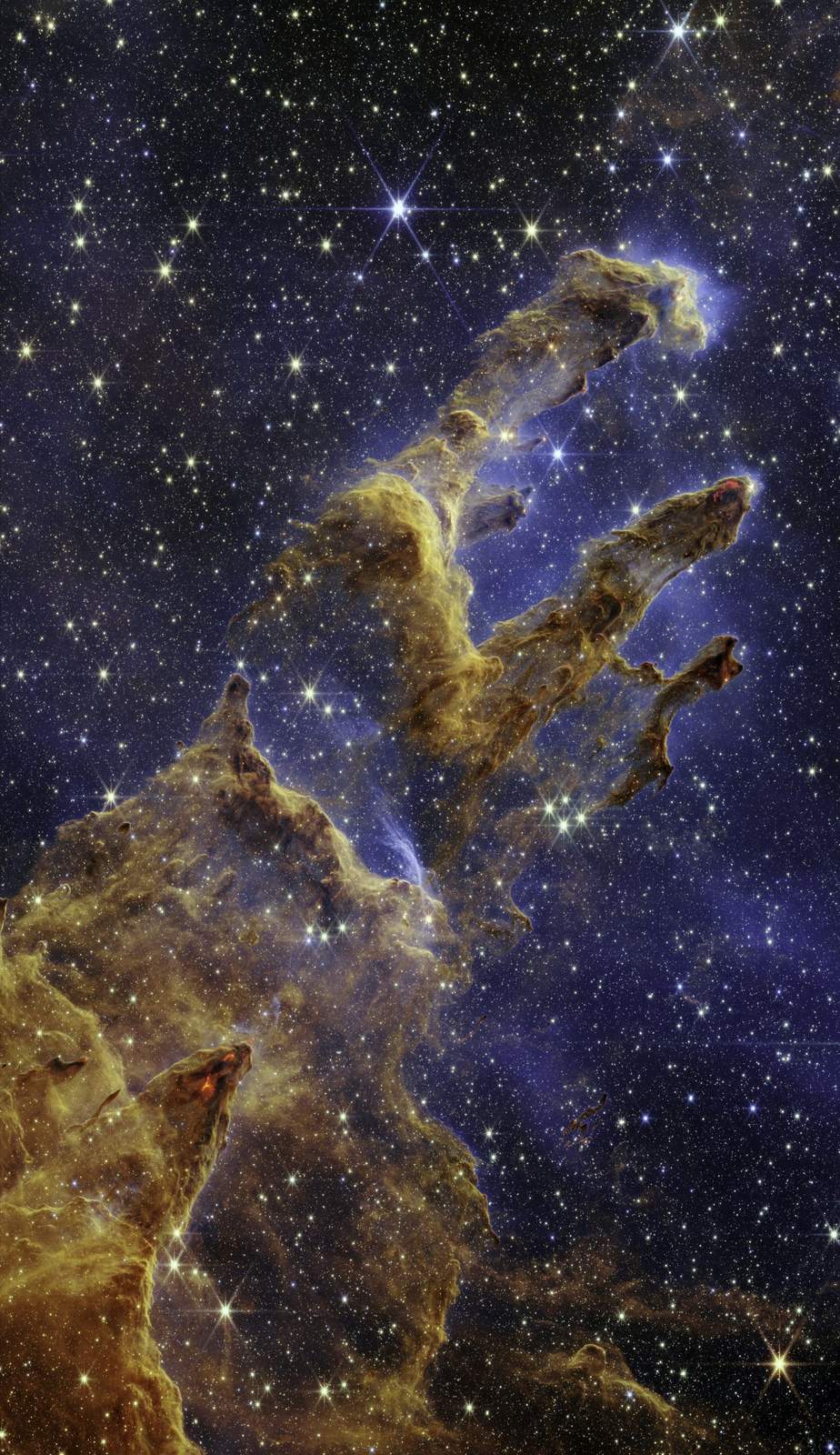
In October 2022 Webb’s near-infrared camera photographed the same pillars, and the comparison is one of the most instructive pairs in astronomy. In Webb’s Pillars of Creation, the columns turn translucent and amber, the background fills with stars, and bright red orbs near the pillars mark newly formed stars. Webb did not replace Hubble’s pictures. It answered them. Hung side by side, the two make a striking pair for a hallway or a stair wall: Webb’s is a tall, narrow print, while Hubble’s is nearly square.
Webb did not replace Hubble’s pictures. It answered them.
A window full of galaxies
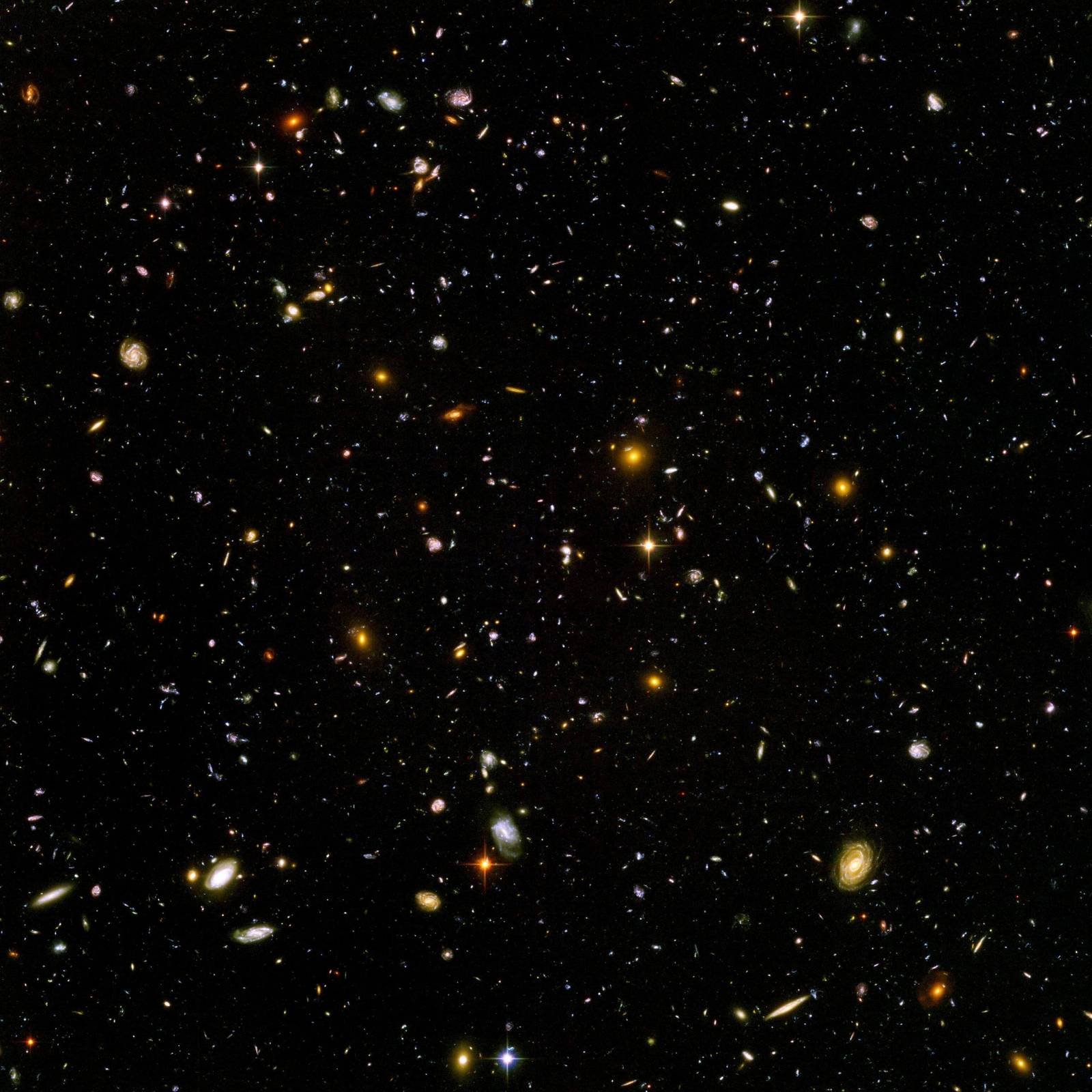
For the Ultra Deep Field, released in 2004, Hubble stared at a tiny, seemingly empty patch of sky in the southern constellation Fornax over many orbits, adding exposure upon exposure. The result holds roughly ten thousand galaxies: spirals, ellipticals and small, faint smudges whose light left them when the universe was young. Almost every point of light in the picture is a galaxy, not a star.
It is the most contemplative print in the collection, and it rewards close looking more than any other. Because it is square, it suits places where a horizontal picture would feel cramped: a narrow wall between two windows, a nook beside a bookcase, or a pair of square prints hung together. The Orion Nebula, Hubble’s 2006 mosaic of the nearest large stellar nursery to Earth, is also square and makes a warmer, more colorful partner.
Webb’s first season
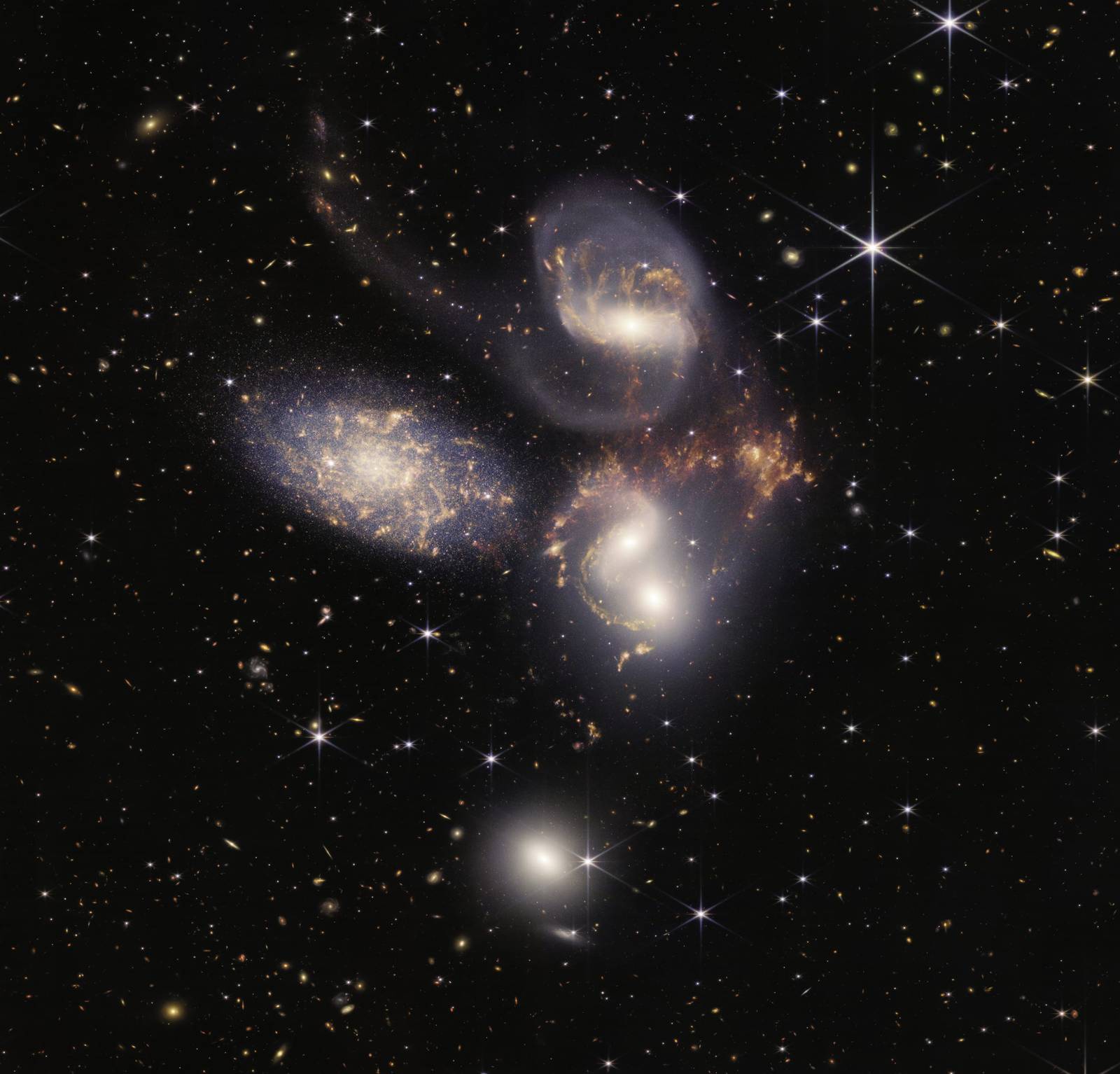
When NASA released Webb’s first full-color images in July 2022, Stephan’s Quintet was among them. The group, in the constellation Pegasus, looks like five galaxies in a cluster, but only four are truly close together, roughly 290 million light-years away, while the fifth sits much nearer to us along the same line of sight. The four interacting galaxies pull at one another, drawing out curving tails of stars and setting off shock waves in their gas. Webb’s view combined its near- and mid-infrared instruments into a large mosaic.
For a print, Stephan’s Quintet works like an abstract painting: soft golden forms, scattered sparks and a deep field of background galaxies. It is nearly square and holds up well at the largest size. For something bolder, Cassiopeia A, Webb’s 2023 view of the expanding remains of an exploded star, is all pink and orange knots in a smoky shell, a picture that suits a modern room with plenty of neutral wall around it.
Choosing a size and frame
Every FrameAnyPhoto print comes in up to three sizes, Small at $195, Medium at $295 and Large at $395, framed and ready to hang, with free shipping in the US. We never crop an image to fit a standard shape, so each print keeps the proportions NASA released. That means the exact dimensions vary from work to work, and they are listed on each work page. A few rules of thumb:
- Go large where you can. Deep-space images are full of fine detail, and the Ultra Deep Field and Stephan’s Quintet in particular reward a size that lets you step close.
- Black frames suit almost all space prints. A slim black frame continues the darkness of space to the wall and keeps attention on the light inside the picture.
- Think in pairs. Hubble and Webb versions of the Pillars, or two square prints such as the Ultra Deep Field and the Orion Nebula, make a balanced pair over a desk or bed.
Our longer guide to choosing a size and frame covers measuring and hanging in more detail.
A gift that keeps looking outward
Space telescope prints have become one of the easiest gifts to get right during the holidays. They suit children and grandparents alike, they sit comfortably in offices and bedrooms, and they come with a story the recipient can look up for years. If the person you are shopping for prefers the human side of spaceflight, our guide to the Apollo photographs is a good place to continue, and the full space collection includes shuttle, Apollo and Artemis pictures alongside the telescopes.