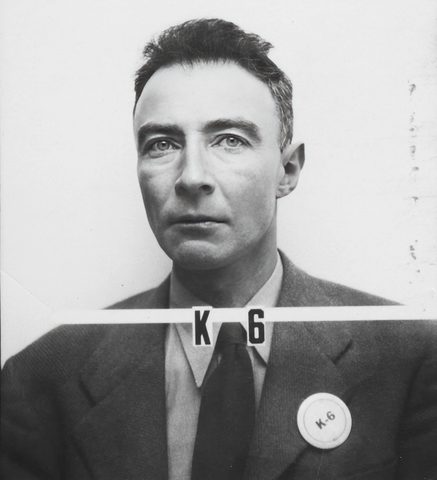
J. Robert Oppenheimer
Los Alamos National Laboratory, 1944
J. Robert Oppenheimer's Los Alamos badge photograph, from about 1944, when he directed the laboratory. From the Los Alamos National Laboratory.
About this work
This is J. Robert Oppenheimer's identification badge photograph from Los Alamos, taken in about the 1940s and published by Los Alamos National Laboratory in its history of laboratory badges. Oppenheimer, born in New York City in 1904, was a theoretical physicist with a chemistry degree from Harvard and a doctorate from the University of Göttingen, where he studied under Max Born. During the Second World War he was the first director of the Los Alamos Laboratory, the Manhattan Project's secret laboratory on the Pajarito Plateau in northern New Mexico, whose mission was to design and build the first atomic bombs. He led it from 1943 until December 1945, when Norris Bradbury succeeded him, and he is often called the "father of the atomic bomb." The laboratory was overseen by the University of California in partnership with the United States Army, and it was placed on the isolated plateau so that its scientists could talk freely about their work while keeping it secret. Oppenheimer died in 1967.
Sources: Wikimedia Commons · Los Alamos National Laboratory: Badges · Wikipedia: J. Robert Oppenheimer · Wikipedia: Los Alamos Laboratory
FAQ
Where can I buy a framed print of J. Robert Oppenheimer?
Here. J. Robert Oppenheimer is available as a framed print in two sizes: Small (18 × 20 in) for $195 and Medium (22 × 24 in) for $295. Prices include the frame and US shipping; delivery takes 14–21 days, with 30-day returns.
What size works best for J. Robert Oppenheimer?
The file is 3,247 × 3,568 px. Small (18 × 20 in) is the largest size that prints at 150 ppi or more (178 ppi), the sharpest choice for close viewing; Medium (22 × 24 in) prints at 148 ppi, fine from a few feet away but softer up close.
Is it legal to print J. Robert Oppenheimer?
Very likely, and here is the basis. The photograph comes from the historical collection of Los Alamos National Laboratory and is published as a public-domain work made for the U.S. government's Manhattan Project. The photographer is not named, so we state the basis rather than promise it. We print it on that basis.

















