
Castles have a pull that few buildings share. Children draw them before they can spell, adults plan whole trips around them, and the painters of the eighteenth and nineteenth centuries returned to them again and again. A castle on a hill gives a landscape a center, a story and a sense of age, which is exactly why a castle picture works so well on a wall.
This guide walks through the castle paintings and photographs in our collection, from Ludwig II’s fairy-tale palaces in Bavaria to Edinburgh, the Alhambra and Hamlet’s Elsinore, then offers a few ideas on rooms, sizes and frames. You can see every one of them in our castles collection.
A castle on a hill gives a landscape a center, a story and a sense of age.
The fairy-tale castles of Bavaria
The most famous castle in the world is not much more than 150 years old. King Ludwig II of Bavaria began building Neuschwanstein in 1869 on a rocky ridge above a gorge near Füssen, as a romantic retreat inspired by medieval legend and by the operas of Richard Wagner, whom he admired. It was still unfinished when Ludwig died in 1886. Today it is one of the most visited castles in Europe, and it is often named as an inspiration for Disneyland’s Sleeping Beauty Castle.
We have two views of it. Hubert Sattler, an Austrian painter known for his detailed views of real places, painted Neuschwanstein with the white towers rising from the forested cliff and a lake and mountains behind. And the Detroit Publishing Co. issued Neuschwanstein, Upper Bavaria as a photochrom between 1890 and 1905. Photochroms were black-and-white photographs turned into color prints by a lithographic process, and their soft, slightly unreal colors suit this castle perfectly.
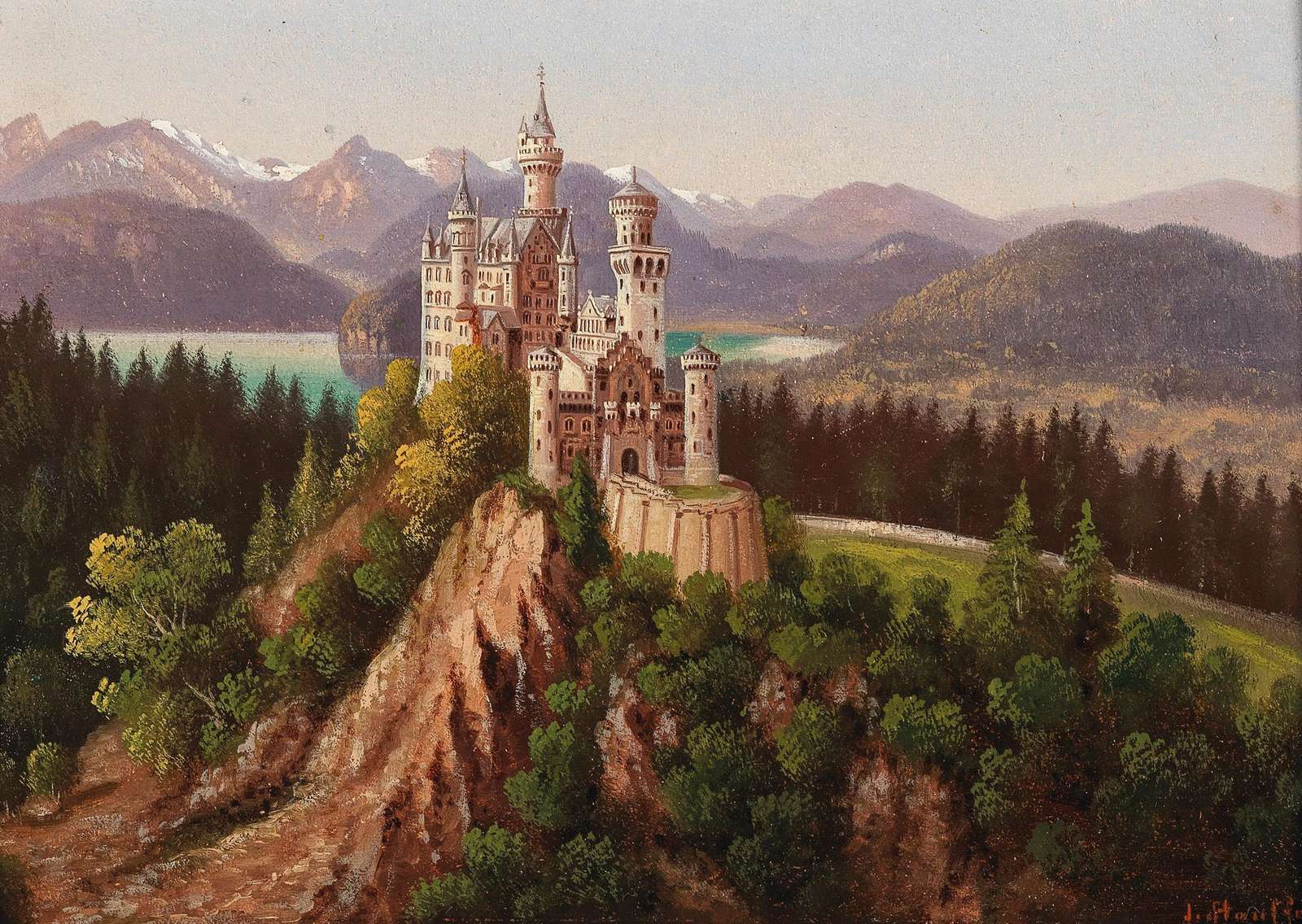
Sattler also painted Schloss Linderhof, the smallest of Ludwig’s palaces and the only one he lived to see completed, with its tall fountain shooting up in front of the facade. Nearby in Württemberg stands Lichtenstein Castle, built in the early 1840s on a narrow cliff for Count Wilhelm of Württemberg, who was inspired by Wilhelm Hauff’s 1826 novel Lichtenstein. The photochrom shows it perched on its rock like something out of a storybook.
Britain: Edinburgh, Alnwick and Windsor
Edinburgh Castle sits on Castle Rock, the plug of an ancient volcano, high above the city. The View of Edinburgh Castle attributed to the Scottish painter Alexander Nasmyth (c. 1800) shows the fortress crowning the cliffs in warm evening light, with figures on the slopes below.
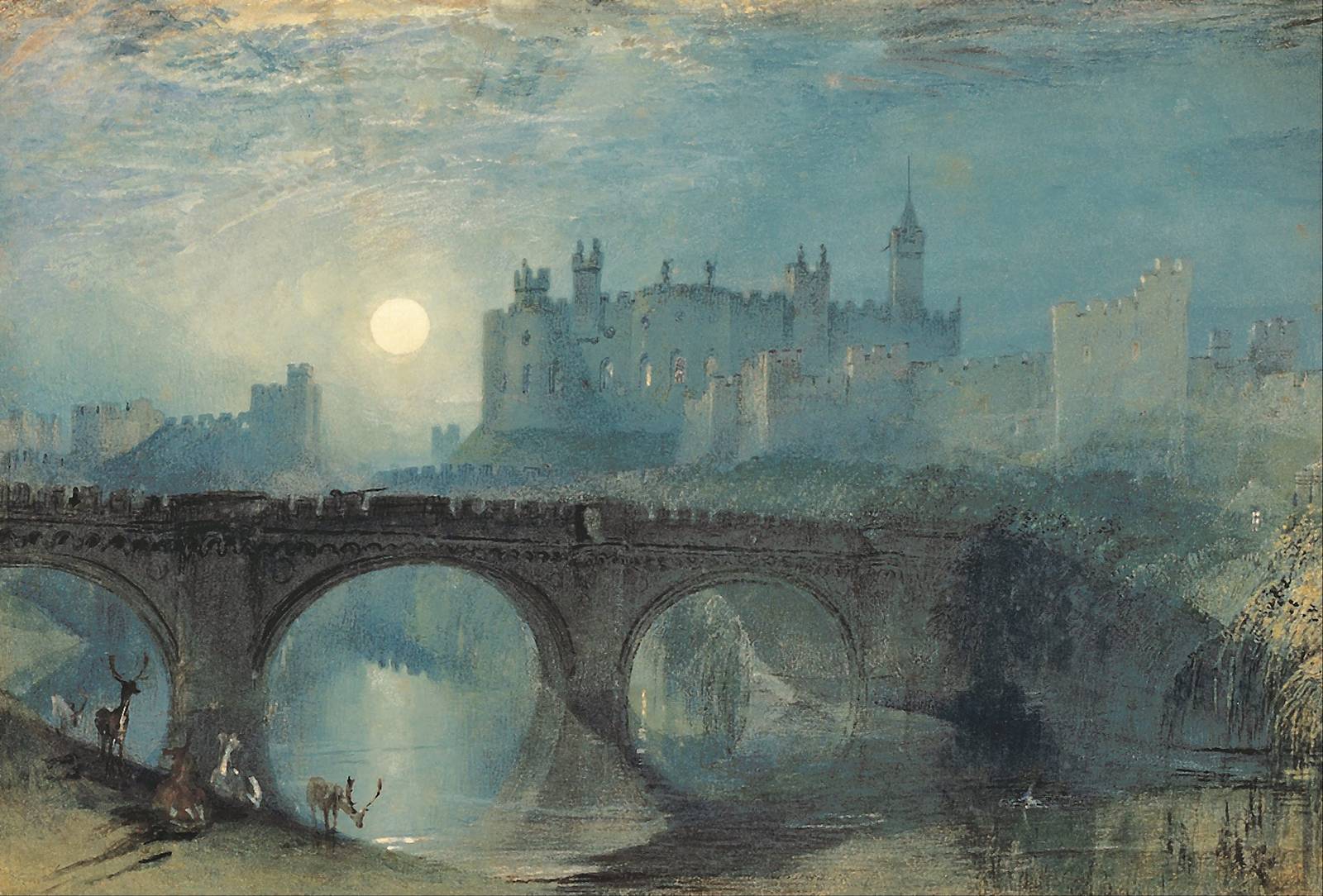
J. M. W. Turner painted Alnwick Castle (c. 1829, Art Gallery of South Australia), the Northumberland seat of the Dukes of Northumberland, as a watercolor by moonlight. The castle glows pale above the river, and the arches of a stone bridge are mirrored in the water in the foreground. It is one of the quietest and most beautiful pictures in the collection.
For something warmer, Alfred de Bréanski’s Windsor Castle at Sunset (c. 1890) sets the royal castle on the horizon above the Thames, the sky and water washed in gold. Windsor, founded after the Norman Conquest, is still a working royal residence.
Scandinavia and the Alps: Kronborg, Chillon and Bled
Kronborg Castle at Helsingør, Denmark, is the Elsinore of Shakespeare’s Hamlet. For centuries it guarded the narrow strait between Denmark and Sweden, where passing ships paid a toll to the Danish crown. Carl Bille, a Danish marine painter, shows exactly that in Kronborg Castle with Shipping (c. 1860): a steamship and sailing boats crossing choppy water, with the castle low on the shore beyond. It is a good pick for someone who loves both castles and ships.
On Lake Geneva, the Château de Chillon stands on a rock at the water’s edge near Montreux, made famous by Lord Byron’s 1816 poem The Prisoner of Chillon. Janus la Cour’s The Castle of Chillon on Lake Geneva (1897) is unusual and lovely: the castle wall fills one side, and the rest is still water and distant mountains. In Slovenia, the View of the Castle and Island on Lake Bled attributed to Anton Karinger (1862) shows the medieval castle on its cliff above one of the most beautiful lakes in the Alps.
Turner’s Alnwick Castle by moonlight is one of the quietest and most beautiful pictures in the collection.
Spain and France: the Alcázar, the Alhambra and Carcassonne
David Roberts, the Scottish painter best known for his views of Egypt and the Holy Land, traveled through Spain in the early 1830s. His The Alcázar of Segovia (1836) makes the most of the fortress’s great square tower rising above the rocks. Edmund Wodick’s The Alhambra, Granada (1886) looks across the valley to the red-walled palace-fortress of the Nasrid sultans, with snowy mountains beyond.
In southern France, the walled city of Carcassonne was heavily restored in the nineteenth century by the architect Eugène Viollet-le-Duc, and it is now a UNESCO World Heritage Site. Émile Roumens’s The Walled City of Carcassonne from the Aude shows the long line of towers above the river, with washerwomen on the bank in front. On the Normandy coast, Théodore Gudin’s Mont Saint-Michel in a Storm (1830) turns the fortified abbey into pure drama, the rock lit against black clouds.
Romantic ruins and Old Masters
Not every castle picture needs towers intact. Heidelberg Castle, above the Neckar River, was badly damaged in the wars of the late seventeenth century and left largely in ruins, which made it a favorite of German Romantic painters and poets. Carl Philipp Fohr, a gifted young painter who drowned in Rome in 1818 at just 22, painted the View of Heidelberg Castle from the East in 1813–14, the ruin glowing in hazy sunlight above the trees.
Much earlier, the Dutch master Jacob van Ruisdael painted Bentheim Castle (c. 1653), a castle just over the German border that he painted many times. In his hands the modest hill it stands on becomes a steep wooded mountain, a reminder that landscape painters have always improved on the view. And for Central Europe, Tavík František Šimon’s Karlštejn Castle near Prague (c. 1910) shows the Gothic castle founded by Emperor Charles IV in 1348 above a sunny village.
Decorating with castle pictures
- Studies, libraries and stairways. Castles suit rooms with books, wood and a bit of history. A stairwell wall is a natural spot for a tall one, like Lichtenstein or the Alcázar.
- Kids’ rooms. Neuschwanstein and Lichtenstein are as close to storybook castles as real buildings get, and they will still look good when the child is grown.
- Color. The Bavarian views are fresh greens and blues; Turner’s Alnwick is cool blue-gray; Windsor and Heidelberg are warm gold. Match the picture to the room’s light and fabrics.
- Size and price. Most works come framed in three sizes: Small at $195, Medium at $295 and Large at $395, printed at the original’s true shape without cropping. A wide view like Carcassonne or Windsor looks best Large over a sofa or sideboard; a single tower works well at Small or Medium. Each work page lists exact dimensions, and our size and frame guide has more tips.
- Frame. The gold Wood Ornament frame suits the paintings; the slim Black Metallic frame suits the photochroms and gives any castle a cleaner, modern look.
- As a gift. A castle someone has visited, or always meant to, makes a thoughtful holiday present. Delivery takes about 14 to 21 days, so order by early December for Christmas.
For more architecture on the wall, see our guide to cathedral paintings and Venice paintings, or browse all castle paintings and photographs.